

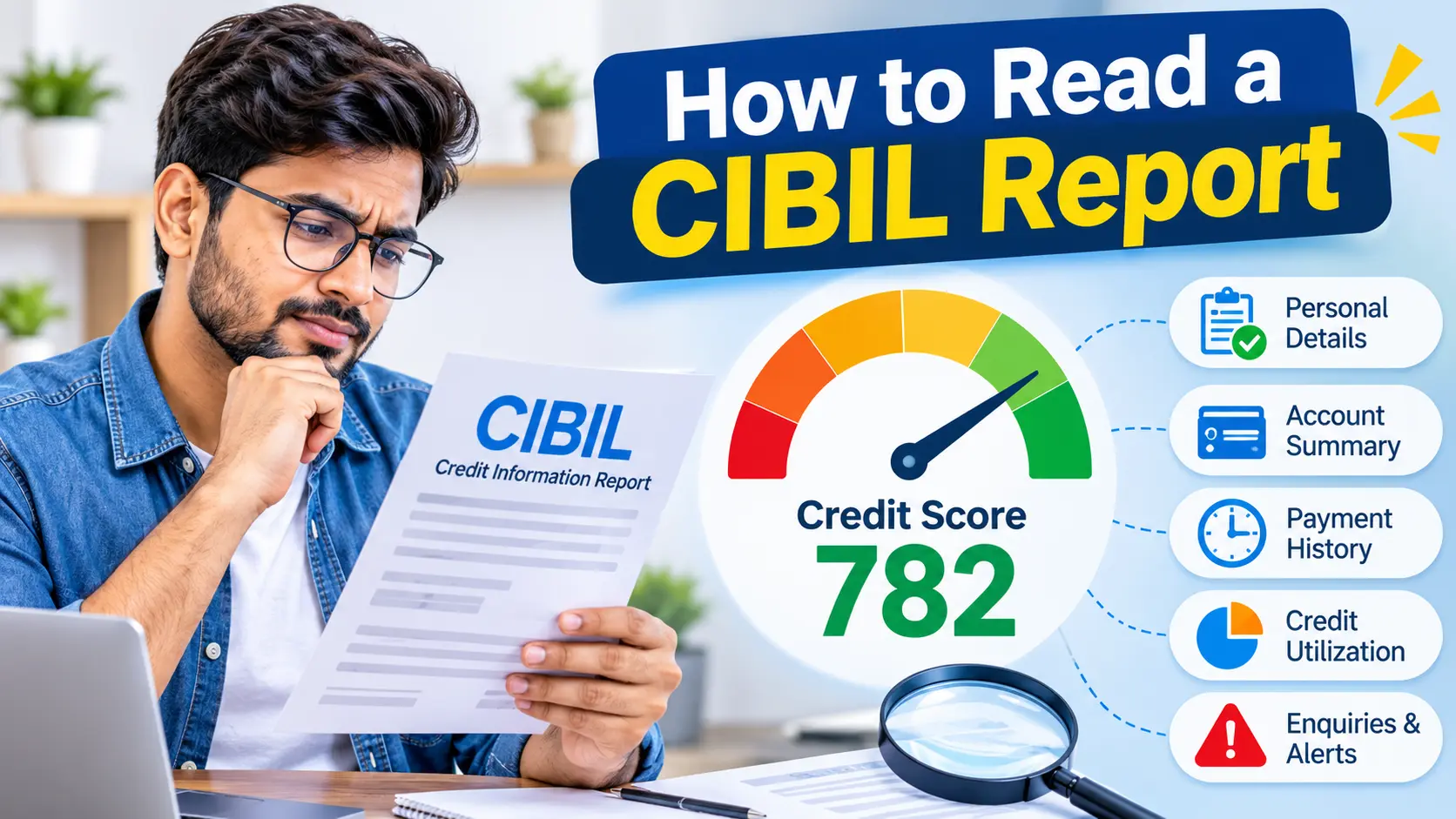
A good CIBIL score means that a person is
creditworthy and pays all their bills on time. But what if you do all of this,
but still, somehow, your CIBIL score is low? This is why learning how to read a
CIBIL report is important. A CIBIL report gives you a comprehensive snapshot of
how your credit history is recorded and shaped. It shows not only your personal
information and CIBIL score but also your accounts, financial information,
lender names, and much more. Each section is important for you to take corrective
action.
Not only you, but lenders or banks can also check your credit report, known as a hard inquiry. However, no unauthorized person can do this without your permission. This doesn't mean that these institutional bodies keep checking your report indiscriminately. They mostly do so when you apply for any credit or loan.
When you check your personal credit score and report, it is known as a soft inquiry, which remains confidential to you. Any other background screening or pre-approved offer eligibility is done via a soft check, so there is nothing to worry about.
What is a CIBIL score?
A CIBIL score is a numeric evaluation of your creditworthiness and repayment behavior, spanning a range of 300 to 900. It is calculated by credit bureaus like CIBIL and Equifax with different scoring models.
Most lenders and banks prefer a 750+ score across financial products and services. However, even a 680 to 700 CIBIL score is also considered good. However, this doesn't really put you on the priority list in the market competition for loans, credit, and financial products. This is very beneficial when a lender decides whether to give you a loan. They prefer low-risk individuals with a stable repayment history so they are confident that you will pay it back. For large-ticket loans, they may also look for a stable and safe income threshold.
Factors that affect a CIBIL score
Some factors are assigned various percentages in different scoring models, algorithms, and credit bureaus when calculating your CIBIL score. Apart from slight differences, these factors remain the same across calculations. Learn how these factors contribute to your credit score when learning how to read a CIBIL report.
1. Repayment History
Repayment history is the most important factor impacting the score. Lenders report to bureaus on a set schedule whether the EMIs and credit card bills are being paid on time or if there are any defaults. Any delay, settlement, or default in any case will adversely affect your credit history.
Positive Effect
●
EMI payments before the deadline
●
Paying the credit card bills in
full
Negative Effect
●
Missing EMIs
●
Late payment of credit card bills
●
Defaulting on the loan
2. Credit Utilization/Due Amount
It reflects how much you have borrowed against the credit limit assigned to you.
For instance,
Credit card limit: ₹1,00,000
Outstanding credit card balance: ₹30,000
Credit utilization = 30%
It is advisable to keep credit utilization below 30% in general. Higher credit utilisation means that you are credit-dependent or in a debt trap, which affects your score negatively. This also reduces your debt-to-income ratio.
3. Credit Mix
A credit mix that is incorporated naturally consists of both secured and unsecured loans. This helps a lender know that you have experience in managing not just one but different types of credit.
●
Home Loans
●
Personal Loans
●
Credit Cards
●
Consumer Durable Loans
4. Number of Credit Inquiries/New Credit
Every time a new loan/credit card application
is submitted, a hard inquiry takes place. If a person submits too many loan
and/or credit card applications, then the lenders might think that he/she is
highly dependent on credit, and therefore his/her score gets negatively
affected. These inquiries will be covered in a section as you learn how to read
a CIBIL report.
5. Length of Credit History
Older credit accounts contribute towards a
positive credit history since the credit age shows total experience and a
greater number of ‘accounts’, as there is more history. This helps establish a
better pattern of repayment behavior because of the longer history across loan
accounts.
Different sections of a CIBIL Report
Apart from the CIBIL score, your CIBIL report
has various other sections. The CIBIL score reflects the information in the
accounts and enquiry sections. Familiarity with these sections is very
important if you want to learn how to read a CIBIL report.
1. Account information
This section lists all information about the
loan or credit accounts. It reflects the lender’s name, type of loan (like a
credit card or personal loan), and account number. The dates of loan account
opening, the last date when payment was made, and the overdue amount—these are
some of the data stored here. This can reflect information for 2-3 years of
activity.
2. Profile Information
This section lists your personal information,
like date of birth, gender, name, and addresses. This also contains a voter ID,
tax, passport, Aadhaar, and PAN number. This also specifies up to 4 address
types, ranging from residential to office addresses. This is where you can
raise disputes for wrong personal information or mismatched names.
3. Contact Details
This section contains information like mobile
number, email address, previous addresses, etc. Incorrect contact information
can expose you to identity misuse; therefore, raise disputes after checking.
4. Employment details
This section shows your occupation, account
type, date reported, and income details like monthly and gross income. Not all
lenders provide this information.
5. Enquiry Information
This list shows all the hard inquiries and Enquiry Control Number (ECN) on every application you make. This includes the date of application, lender name, date of inquiry, type and amount of loan, etc.
Various terms you read on a CIBIL report
You may come across these common terms when
analyzing your credit report. Go through these abbreviations and meanings as
you learn how to read a CIBIL report:
1. Asset Classification:
These are the various categories of DPD
(Days Past Due).
STD
Standard: Payments are made within 90 DAYS,
after which it is listed as a non-performing asset.
SMA
This is the Special Mention Account, reported
for those showing early signs of financial stress before they can be classified
as non-performing assets. This is a warning of three types: SMA-0, SMA-1,
and SMA-3. SMA-0 is not applicable for revolving credit. The first one
is a delay of 1 to 30 days, the next is 31 to 60 days, and the last one is 61
to 90 days.
SUB
Sub Standard: A person remains NPA for over 12
months.
DBT
Doubtful: An account is SUB for a year.
LSS
A person who has been classified as an
unrecoverable loss.
2. Amount Overdue:
The total amount of principal and interest
that is yet to be paid to the lender.
3. Cash Limit:
The amount of cash you are permitted to withdraw
from your credit card
4. Credit Limit:
The amount of revolving credit you have been
using against the maximum limit, beyond which you can’t borrow.
5. Days Past Due:
This is the number of days that a payment is
late after the due date of the month, which is also denoted as 000, 030, 060,
and 090 depending on the number of days.
6. Ownership:
This shows who is responsible for the loan
repayment; it could show a single, joint, authorized user, or guarantor.
7. Suit Filed/WILFUL DEFAULT
This shows legal action taken by the lender
for loan recovery, such as a lawsuit or civil suit. "Wilful default"
means a person is financially capable of paying a loan but willingly doesn't
pay it off.
8. Written off:
This is the debt that the lender or bank has
cleared from their records because of a long period of inactivity and considers
it a loss or unrecoverable.
Red Flags when you read a CIBIL report
Identifying red flags is a protective measure
to safeguard your credit from unidentified scams and frauds. This is the next
step in learning how to read a CIBIL report.
1. Personal Information Mismatch
Check for:
●
Mistaken name spelling
●
Wrong PAN number
●
Incorrect date of birth
●
Unrecognized addresses
2. Repaid Loans Listed as Open
Another problem faced while reporting involves showing closed loans as open, even if you repaid the full amount.
This would:
●
Add to your debt load.
●
Affect loan eligibility
● Confuse underwriting
You must dispute this with CIBIL as well as the lender concerned.
3. Unfamiliar Accounts
Finding accounts that were never opened might mean:
●
Reporting problems
●
Identity theft
● Credit fraud
It is advised to investigate this issue right
away.
4. Credit Utilization of 70-80%
High utilization of credit card limits may be
seen as credit dependency. Pay down your balances to keep it at 30%.
5. Multiple Hard Inquiries
Multiple hard inquiries recently could mean
financial difficulties. Do not apply for several loans at the same time.
6. Late Payments
Even one late payment can affect your credit score. Check the payment history carefully for:
●
Late payments for 30 days
●
Late payments for 60 days
●
Late payments for 90 days
7. Written-Off Account
The written-off account is considered one of
the most damaging negative entries. This data can greatly affect your chances
of getting credit in the future.
8. Settled Account
People often think that a settled account
equals closing the account or forgiving the loan. However, settlement means
partial payment of debts and affects future credit decisions. If possible, get
a no-dues certificate and pay any remaining amount. This is because even after
settlement, it only shows a negative mark called ‘settled’ instead of
‘due/written off/NPA.
9. Duplicate Account
The same loan may be listed several times due to merged files or a data reporting error. It inflates your debt even for closed
accounts.
10. Incorrect Outstanding Balance
Your outstanding balance has to correspond to
your loan statements. The inflated balance affects the debt-to-income ratio.
How to read a CIBIL report: Step by step
Learn a step-by-step, simple process of how to read a CIBIL report.
- Start by
reviewing your personal details like name and address to ensure there are
no mismatched details or reporting errors.
- Check your
employment details. Even for some of these sections, they do not affect
your credit score calculation; any incorrect entries can expose you to
fraud risks and loan rejections.
- Analyse
every loan and credit card account, along with DPD, for any duplicates or
closed but open accounts.
- Check hard
inquiries for any unrecognized lenders or unfamiliar applications you
don't remember making. This is a very crucial part for identifying
identity fraud.
- Raise disputes for any information that looks suspicious or wrongly entered. This is the ultimate goal of understanding how to read a CIBIL report.
Conclusion
Reading only the CIBIL score can be harmful. One should conduct a thorough study of all factors in your credit report, including loans and credit accounts, profile details, addresses, emails and mobile numbers, account numbers, ownership details, and much more. Focus on each and every minute detail in your credit report. This is why learning how to read a CIBIL report is important.
By carefully reviewing each section, identifying and filing disputes for every red flag, and unknown account, one can take proactive steps in protecting your credit profile and not fall prey to misinformation. A well-managed CIBIL report keeps you informed and financially healthy, opening doors to a world of financial products.
FAQs
1. What is the difference between a CIBIL score and a CIBIL report?
A CIBIL score is a number or summary of your
creditworthiness, while a CIBIL report contains all the data encompassing your
credit profile and financial activities in credit lines or loan accounts.
2. What is a good CIBIL score?
While the minimum threshold can be called 700,
most banks and lenders widely recognize a good and acceptable CIBIL score
sitting at 750 for loans and credit.
3. How to read a CIBIL report?
➔ Start by reviewing your personal details like name and address to ensure there are no mismatched details or reporting errors.
➔
Check your employment details; any
incorrect entries can expose you to fraud risks and loan rejections.
➔
Analyse every loan and credit card
account, along with DPD, for any duplicates or closed but open accounts.
➔
Check hard inquiries for any
unrecognized lenders or unfamiliar applications you don't remember making.
➔ Raise disputes for any information that looks suspicious or wrongly entered.
4. Does checking my personal CIBIL score reduce it?
A personal credit report is a soft check;
therefore, you can check your credit report as many times as you please.