

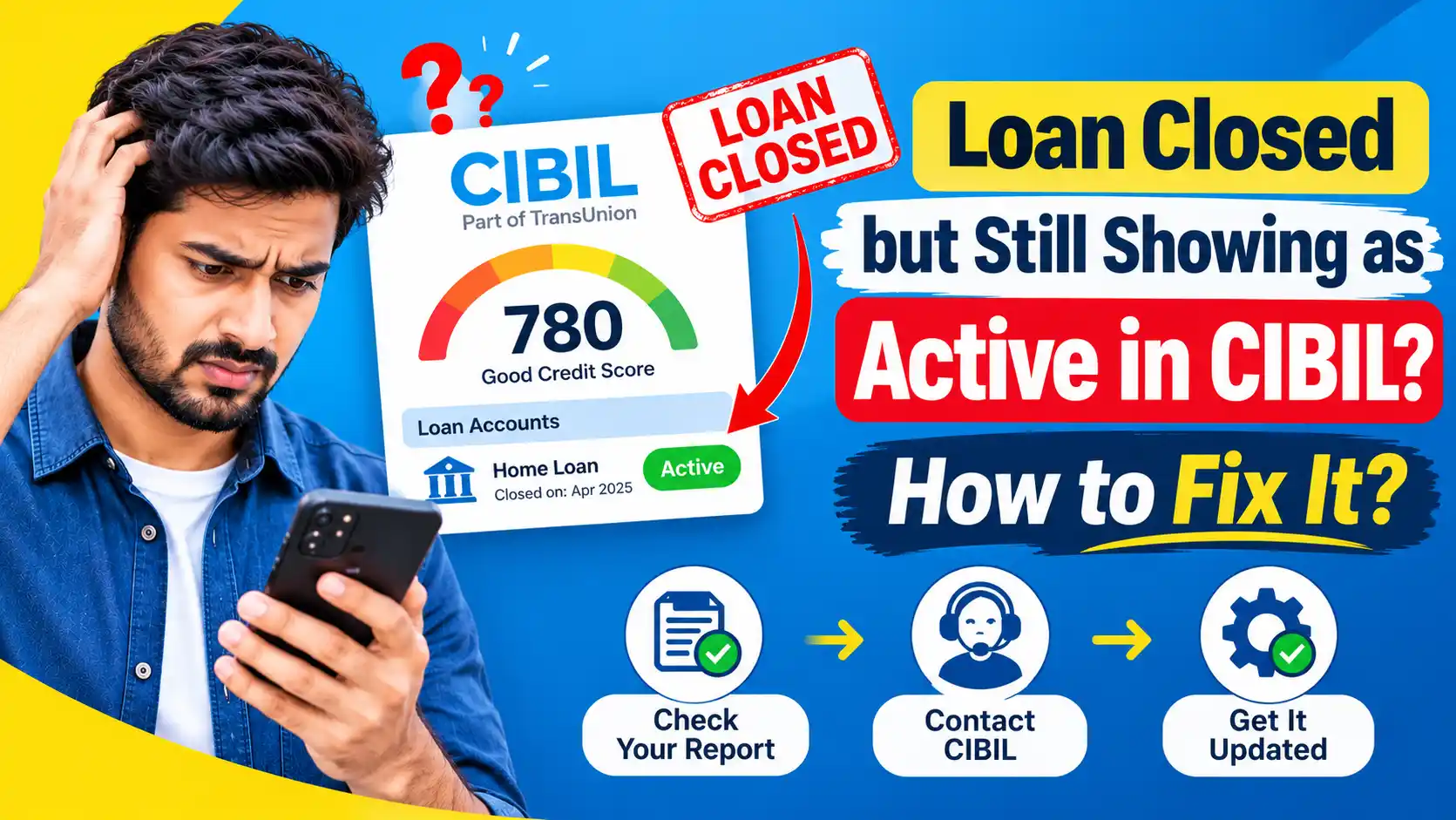
A credit ecosystem is not just about taking
loans and getting them approved with good credit scores. Closing a loan is just
as important as its approval. A user wants to close the loan and feel
stress-free. After all, this is what a credit bureau or lender expects you to
do—responsible management and repayments, rather than default or settlements.
However, some closed loans show as active in CIBIL. It is quite common, not to
worry about, but also baffling.
Why is closing a loan important?
Closing a loan is important because it removes active debt obligations, saves on future interest, and improves your financial standing with authorities.
- It shows
your credit responsibility and repayment efforts.
- It reduces
your interest once you pay off all dues
- It improves
your cash flow by eliminating EMIs and bringing forth financial
flexibility.
- Debt-to-income
is important to lenders, as it shows that you are creditworthy and is an
important factor for loan approval.
- It has a
positive impact on your credit profile, as it shows timely, well-managed,
and responsible borrowing.
- It brings
you psychological relaxation and presents you as less risky.
- Closures
establish you as risk-free and show that you honored the legal obligations
of a contract.
- It is
important for a bank’s portfolio and capital management. Once you clear
your books, they can issue loans to new seekers.
How can a closed loan show as active in CIBIL?
For all credit accounts, your CIBIL report will have data including:
●
Loan amount
●
Balance
●
Payment history
●
Loan status
●
Date of opening
●
Date of closing
● Type of loans
Once the borrower has repaid and the details have been updated in the account by the lender, the loan status should normally be updated from 'Active' to 'Closed'.
'Closed' status means that:
●
You have repaid the loan
completely.
●
You have no balance left to repay.
●
The loan account has been closed.
●
There is nothing left to repay.
1. Delay in Reporting from the Bank
The lenders submit customer account details at periodic intervals to the credit bureaus like CIBIL. It could also be due to incomplete closure formalities.
If you have just cleared your loan, there will be a delay in reporting between:
●
Date of closure of the loan
●
Update submission to CIBIL or to
banks
● Appearing on your credit report
In most instances, the issue is resolved
automatically in the next cycle of reporting, within 45 days.
2. The Lender Fails to Change the Closure Status of Your Account
In some cases, there could be discrepancies within the database of the lender. Though the full repayment of the loan is done, the lender might fail to mark the closure status of the account in the reporting system.
The reasons for a closed loan showing as active could be
●
Administrative error
●
Data mismatches
●
Inaccuracy during data
synchronization
●
Delays due to manual processing
● Technical problem in the reporting system
3. Unpaid Amount for the Loan Account
●
Late payment penalty
●
Interest penalty
●
Bounce charges
●
Reimbursement of processing fee
● Pending small amount
Even a small amount can keep the account from
being reported as closed.
4. Settlement vs. Closure
A loan is closed when:
All loan amounts/obligations have been repaid.
There has been no concession from the lender.
A settled loan is when:
Less than the total outstanding amount has
been paid.
There is a negotiation for a partial waiver of
dues.
The account has not been treated as fully settled.
There could be confusion regarding the two
loan statuses or lack of NOC.
5. Data Entry Errors
Sometimes, mistakes can happen in:
●
Data uploading
●
Account linking
●
Record keeping
● Processing at the credit bureau
An error in reporting can lead to:
●
Incorrect account status
●
Incorrect balance amount
●
Multiple loans
● Closed loan shown as active in CIBIL
Such mistakes must be formally corrected.
6. Duplicate Loan Account Listings
Duplication of accounts causes the status of a closed loan to show as active in the credit report.
As an illustration:
The duplicate listing can be active when the account is closed.
A closed loan showing as active usually happens due to:
●
Loans that were transferred from
one lender to another.
●
Migration of data systems.
●
Improper listing done by the
lenders.
How to fix an active loan error
1. Verify the loan closure
You must verify the closure to prevent score drops or ghost demands.
Check if you possess the following critical documents:
●
Loan closure letter
●
No due certificate
●
Foreclosure certificate
●
Final payment receipt
● Account showing zero balance
2. Contact the lender
Your first point of contact should be the lender.
Reach out through:
●
Customer care
●
Branch office
●
Relationship manager
● Official grievance channel
Explain why you have a closed loan showing as
active with appropriate evidence and request the lender to update, verify, and
report the misinformation.
Step 3: Seek Written Confirmation
Your lender should furnish written confirmation that:
●
The loan amount is fully paid off.
●
No other pending dues exist.
● Closure details have been sent for bureau updation.
This document may prove helpful in case
escalation becomes necessary.
Step 4: Check Credit Report Regularly
Once the creditor updates the information, keep track of your credit report periodically.
Verify that:
●
Status gets updated from Active to
Closed.
●
Outstanding amount becomes zero.
● The closing date is recorded correctly.
Save screenshots or copies for future
reference.
Step 5: Dispute Further
In case of failure to resolve the dispute within a reasonable time frame, escalate the issue through the credit bureau.
How to raise a dispute for the loan status error
An
unresolved dispute is shown as “under dispute", and the user is entitled
to receive compensation of 100 rupees every day after 30 days of delay.
Step 1: Be prepared
Loan account number
Error status
Name of the lender
Go through the entire account information
carefully.
Step 2: Collect Your Proof
Have the following documents prepared:
●
Loan closure certificate
●
No Due Certificate
●
Proof of repayment
●
Statement of foreclosure
●
Email from the lender
● ID proof if required
Collecting evidence always helps you solve the
dispute faster, as it is a mandatory requirement for the process.
Step 3: Raise a Dispute
Go to the CIBIL login portal→ dispute center→submit details:
●
Loan account number
●
Type of error
●
Correct status of the loan
● Date of closure
Attach documents wherever necessary.
Step 4: Verification by the Lender
Now what happens?
●
The lender verifies the account
once the request is received by CIBIL.
●
Internal verification takes place.
● The lender informs the bureau about the correct information.
It should be noted that credit bureaus rely
heavily on verification by the lenders.
Step 5: Keep an Eye on the Status of the Dispute
All disputes have a reference number.
Use the same to:
●
Keep track of the dispute process
●
Get updates
● See whether the dispute has been sorted out
Keep copies of all e-mails and
acknowledgements.
Step 6: Check the Revised Report
Once you settle the dispute:
●
Download the revised report.
●
Ensure there is no balance
remaining.
● Carefully review all the loan information.
If mistakes are found, act at once.
Ways to Avoid Future Account Status Errors
Although all reporting errors cannot be
avoided, some of the following techniques can minimize your risks:
Safe Keeping of Loan Documents
Closing certificate
Account statement
NDCs
Foreclosure letters
They are required documents even as years go
by.
Regularly Check Your Credit Report
Credit report monitoring is a healthy practice and detects:
Account status error
Loans that you don’t recognize
Personal data error
Duplicate listing
Get Confirmation from the Lender
Never think that after paying back the loan, everything is done; get official confirmation from the creditor.
The loan has been closed.
Balance zero
Initiation of update at the bureau
Following up on Loans Closed through Foreclosure
Some loans that have been closed before tenure might need extra effort.
Conclusion
A closed loan showing as active in CIBIL is one of the problems many people face. Although this error might not necessarily affect your credit score, it creates some issues for you when you apply for a loan or any credit facility.
It is important for you to be certain about loan closure with official documentation, make changes at the bank level, and regularly keep track of your credit report. If there is still no resolution, then it is advisable that you raise a dispute with the credit agency along with appropriate proofs.
FAQs
1. What to do if my dispute is neglected?
If CIBIL fails to resolve your error within 30
days, you are eligible for penalty fees for every day of delay. You can raise a
complaint on the RBI
website.
2. What documents do I need as proof to rectify my loan status?
You might need an NOC or NDC, a foreclosure
letter, proof of final payment, the latest credit report copy, government
identification, bank statements, and lender confirmation.
3. What is the difference between a settled and a closed loan?
A settled loan is when a defaulter fails to
pay the full amount of the loan taken and negotiates for a partial settlement
or a lower repayment amount according to the lender's policy.
4. Can I check my score without a score drop?
You can check your credit report indefinitely,
as it is a soft inquiry and doesn't affect your credit score.