

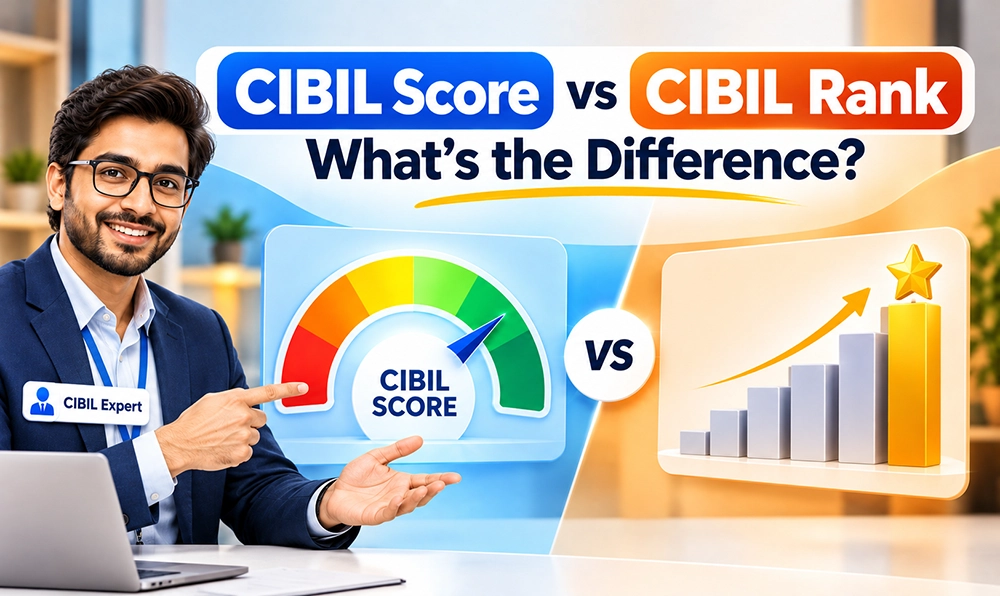
Navigating the financial world requires a clear understanding of how lenders look at risk—especially for a business that deals with money carefully. Many people think of a CIBIL score as something for individuals. A CIBIL rank has a different purpose. CIBIL Score vs CIBIL Rank might be part of what CIBIL does. One is for people or consumers, and the other is for companies or businesses. By instrument, it means a way to check if someone or something can be trusted with credit in certain situations.
What is a CIBIL score?
A CIBIL score is a three-digit number that shows a person's credit history from 300 to 900. TransUnion CIBIL calculates the score based on information given by banks and other financial companies about how someone pays back what they owe.
A CIBIL score of 750 or more is considered good, and this helps a person get a credit card, personal loan, or home loan with better interest rates.
The main things that affect a CIBIL score are
● payment history
● credit usage ratio
● length of credit history
● types of credit used
● number of inquiries
Paying
loans and credit card bills on time is the best way to have a good CIBIL score.
Checking your CIBIL score is known as a soft inquiry and does not hurt your
score. Keeping an eye on your CIBIL score helps you find any errors and see how
you are doing financially, and a high CIBIL score gives you chances for good
financial products.
What is CIBIL rank?
When looking at CIBIL score vs CIBIL rank, the difference is who it is for. A CIBIL score checks the trustworthiness of a person, while a CIBIL rank checks the trustworthiness of a business. Think of a CIBIL score as a credit tool and a CIBIL rank as a business credit measure.
The CIBIL Rank is on a scale of 1 to 10, where 1 means the highest trustworthiness (no chance of not paying back), and 10 means the lowest trustworthiness (highest chance of not paying back).
Banks and financial companies use CIBIL Rank to decide if a small business, medium business, or large company can get a loan. This rank is based on how the business borrows money, how much it owes, how well it pays back, and how it uses credit and the age of its credit accounts.
Getting a CIBIL rank of 1 to 4 makes it much easier for a business to get money for operations and other business loans with good terms and low interest. Business owners need to make sure they pay their debts on time and keep a financial record to make sure their CIBIL rank stays good.
What is a company credit report?
A company credit report is a detailed record of a company’s financial activity, credit history, and how it pays back what it owes. Every financial action becomes part of a picture: how the company is doing in the market, its reputation, and how much it can grow. A company’s credit history is very different from a person's. Its history with suppliers and other credit details are part of the company credit report. Comparing CIBIL Score vs CIBIL Rank, the factors included in both reports are distinct.
Relationships with suppliers are an important and serious part of a company credit report. It shows a lot about how the business runs and how trustworthy it is because getting supplies is the main part of any business. The overall view shows how each financial action helps shape the company's future.
What is credit rating?
Credit
rating is the criterion of judgment used to determine the creditworthiness of a
company or government entity. It is given on a scale from "AAA to D,"
with AAA being the best rating and D being the worst. A good
rating means the company is known for handling debt, while a low rating means
there is risk and financial problems.
How does CIBIL rank affect my business reputation?
It is also known as the CIBIL MSME rank, which is a clear sign of a company’s financial health, how it borrows money, and how reliable it is with debt. A good CIBIL rank also helps build trust with suppliers, investors, partners, and others.
In any discussion of CIBIL score vs CIBIL rank, a business rank clearly helps shape the company’s reputation with people who matter.
Direct Effect of Credit Rank on Business Reputation for Various Stakeholders:
1. Banks and Institutional Lenders:
High Standing (Credit Manager Rank 1 to 4) shows that the business is careful, with money not likely to fail. It creates a good reputation with banks, which results in low-interest loans, rapid loan processing, elimination of collateral requirements, and increased working capital limits. A low standing (credit manager rank 5 to 10) indicates high risk, high gearing ratio, or irregular payment behavior.
2. Suppliers & Vendors (Reputation for Trade Credit):
The suppliers of raw materials and vendors check the commercial credit report prior to offering trade credit. A high rank ensures flexible interest-free terms (such as Net-60 and Net-90) in contrast to cash payments upfront.
In case of a low rank, the vendors perceive the company as risky and might apply strict cash-on-delivery conditions, request advance payments, or reduce supply chains during busy times.
3. B2B Clients & Enterprises:
The
corporate customers and government entities evaluating tender bids or long-term
supply agreements look for stability and reliability. A high rank indicates the
firm's financial stability to ensure that the project will be completed without
insolvency issues.
A low rank raises doubts about the company's stability and risks of supply problems or legal conflicts, making it unlikely for enterprises to enter into vendor contracts.
4. Investors & Venture Capitalists
A high rank increases credibility when raising funds for mergers and acquisitions. It reflects efficient management of the debt burden and helps to maintain the equity value.
A low rank signals an uncontrolled debt burden and poor cash flow hygiene, affecting the enterprise value or deal-making during the due diligence process.
What does a good CIBIL rank do for my business?
● Direct access to capital and
lower interest rates
● Trade credit, favourable
vendor terms and relationships
● Enterprise valuation and equity funding
Difference between CIBIL Score vs CIBIL Rank
To clearly map out differences between CIBIL score vs CIBIL rank, check the parameters explained below:
|
Pointer |
CIBIL score |
CIBIL rank |
|
Target entity |
Individuals like consumers and retail
borrowers. |
Businesses like SMEs, MSMEs, and
corporations. |
|
Range |
300 to 900 |
1 to 10 |
|
Scale evaluation |
The higher the score, the better it gets
(750+ is ideal). |
Lower is better (1 is the highest rank). |
|
Factors considered |
Credit utilisation, personal repayment
history, personal lines of credit |
Commercial borrowing history, payment track
record on business records, company credit limits |
|
Report type |
Credit information report |
Company credit report |
|
Primary use |
Personal loans, home loans and other
personal lines of credit |
Business and commercial credit evaluation,
network and supply |
Although
both CIBIL Score vs CIBIL Rank are vital credit assessment tools formulated by
TransUnion CIBIL, the two have vastly different target audiences and financial
purposes. The primary role of the CIBIL Score is to assess the creditworthiness
of individuals as consumers and borrowers in terms of consumer loans and credit
cards for retail banks.
On the other hand, the primary function of a CIBIL Rank is to assess the financial standing and credit risks of companies, including SMEs, MSMEs, and corporations, in order to establish corporate borrowing limits and working capital eligibility.
In addition to the differences in functions, the numeric scales of CIBIL score vs CIBIL Rank are based on opposite principles. The CIBIL Score is rated from 300 to 900, where a higher score means better financial stability and is preferred for approvals of home, auto, and personal loans.
Meanwhile, a CIBIL rank is ranked on a scale from 1 to 10, with lower numbers indicating better standing of the company. For instance, if the company has a rank between 1 and 4, then the company is considered low-risk and thus can obtain commercial loans and trade credit with ease.
The data underlying each factor creates a starker contrast between the purposes of CIBIL Score vs CIBIL Rank. The factors affecting the CIBIL score are payment history, credit mix, credit usage, credit age, etc. A commercial CIBIL rank analysis examines:
● corporate borrowing history
● business credit-to-debt
ratios
● repayment history on
commercial lines of credit
● supplier transactions
● enterprise resilience
How to improve business credit rank?
● Keep an Excellent Record of Loan Payments: All EMI payments, credit line payments, and credit card dues must be paid before their due dates.
● Opt for Credit Line Utilization Below 30%-40%: This will not make you look like someone who is greedy for credit.
● Apply for Loans Slowly: Do not apply for loans from various banks at once, as this will affect your ranking.
● Check Commercial Credit Report Periodically: Inaccuracies in CCR need to be challenged promptly.
Conclusion
In conclusion, whereas the CIBIL Score represents personal financial discipline, the CIBIL Rank represents the trust token of an organization within the business environment. Understanding the difference between CIBIL Score vs CIBIL Rank is important for managing borrowing power, securing commercial trade credit, and preserving business reputation.
Having a good CIBIL rank (CIBIL Rank is between 1 and 4) is not just about getting loan approval from banks; it is about establishing a good reputation for the business that gives access to favorable interest rates, trade credits from suppliers, and increased valuation of the business when raising capital. By practicing good financial discipline such as making repayments on time, having low credit utilization, and checking your commercial credit score, businesses can create a robust credit profile.
FAQs
1. How is CMR rating important?
The CMR rating is the ranking CIBIL assigns to MSMEs on a scale of 1 to 10. It is calculated based on the following factors:
● Liquidity risk
● Repayment track
● Firm standing and positioning
2. What is CIBIL Rank 7?
A
CIBIL rank of 7 is a moderate to high-risk number, which leads to higher
interest rates, stricter loan terms, and approval difficulties. Vendors also
deny NET 30 or NET 60 payment terms, leading to cash on delivery. This low rank
is a result of frequent delinquencies, high credit usage, and a high
debt-to-equity ratio.
3. Why is a CIBIL rank important?
CIBIL Rank assigns a definite number to the creditworthiness and risk profile of a company or business. This helps in the efficient evaluation of a credit profile and loan processing for a business. Manage your working capital lines and trade lines to maintain and improve your CIBIL rank.
4. What qualifies as a "good" CIBIL score versus a "good" CIBIL rank?
CIBIL Score – It is said that a score above 750 (maximum score being 900) is considered good by the lender, which increases the probability of fast loan sanctioning along with competitive interest rates.
CIBIL Rank – It is said that a ranking between 1 and 4 (maximum being 10) is considered good for companies, where 1 is the highest rating and indicates low credit risk.
5. How to improve the CIBIL score as compared to improving the CIBIL rank of an individual?
To improve the CIBIL score, the following steps could be followed:
● Timely payment of credit card
bills and EMIs for the loans taken.
● Keeping the credit
utilization ratio less than 30%.
● Maintenance of a good ratio
between secured and unsecured credit.
● No multiple applications for loans and cards at once.
To improve the CIBIL Rank, the following steps could be followed:
● Timely repayment of the
business credit lines and term loans.
● Safe level of working capital
utilization.
● No default or settlement of
commercial accounts.
● Periodic review of the
Company Credit Report (CCR).