

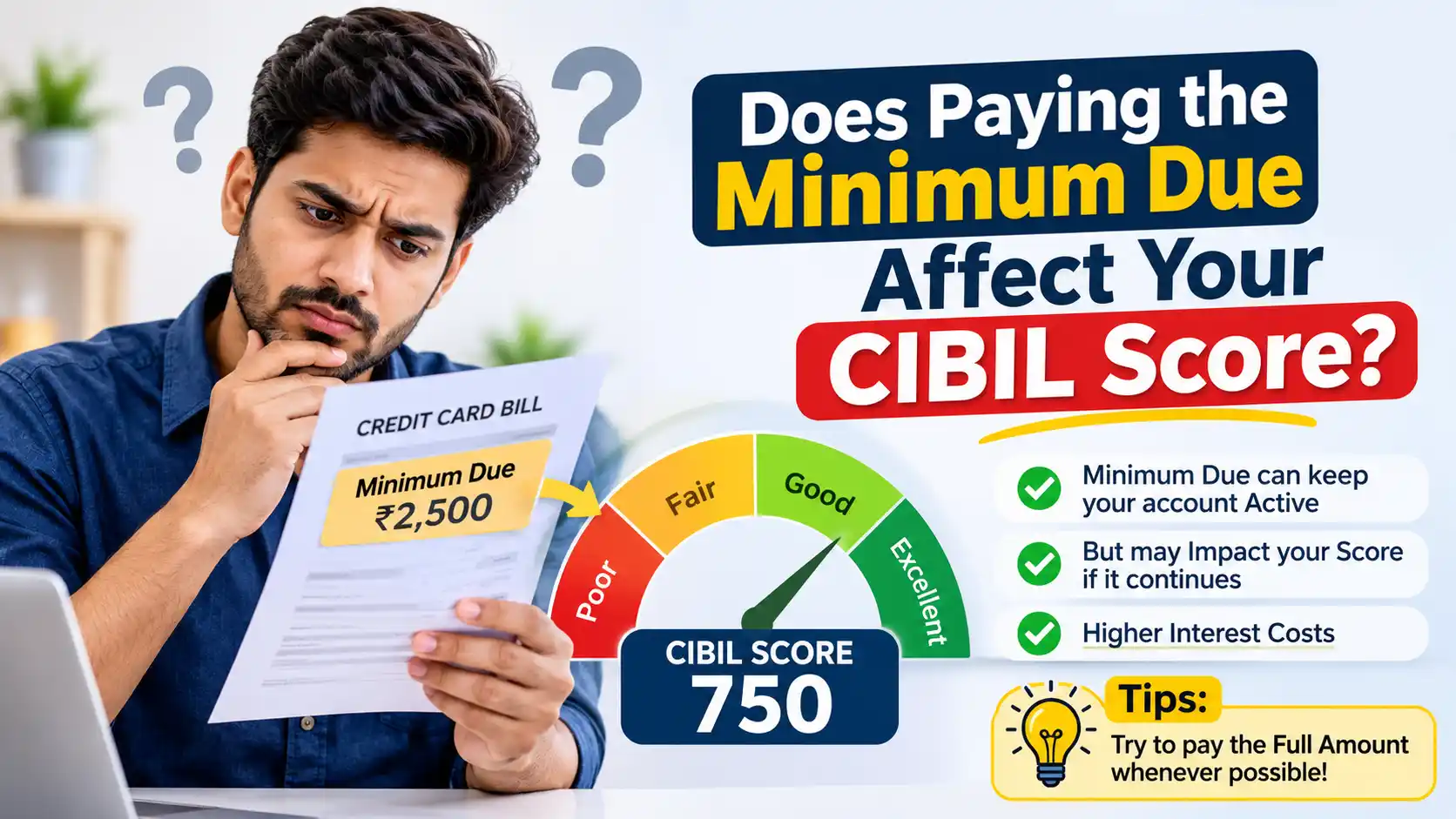
Credit cards are convenient only until the bill arrives. Users now face the tempting question: Should I use the minimum due option?
And why not pay the minimum due? After all, it's not every day you survive another month without paying expenses. In the next moment, you start wondering, “Does paying the minimum due affect your CIBIL score?” Is it actually the right option being displayed?
“On-time minimum due payment is not immediately considered detrimental to your CIBIL score since this helps ensure that your account is not declared overdue. But if you regularly pay off the minimum amount, you run the risk of building up debt, increasing your credit usage, and therefore indirectly harming your credit score."
However, there is a plot twist that
many overlook: paying just the minimum due instantly terminates your
interest-free grace period. High interest charges will be added to the
remaining balance, as well as any further purchases. This grace period lasts
for 55 days, within which you make the full repayment.
Minimum Due on Credit Card
The minimum due is the least amount payable by the deadline of your credit card payment to maintain an acceptable status of the account.
By not making payment of your complete
outstanding bill, you are permitted to make a partial payment as the minimum
due, which is normally 5% - 10% of the total outstanding, depending on the
policy of the concerned bank.
Example
Assuming that your credit card statement shows:
Total Outstanding: ₹20,000
Minimum Due: ₹1,000
You have to pay ₹1,000 before the deadline
date of payment and not become a defaulter in terms of missed payments.
However, ₹19,000 will remain outstanding and will continue to attract interest
charges.
This is one area where most people get confused about the working of the credit card.
Methods of paying back interest
If you keep paying only the minimum due for a
few months, interest can pile up fast. This is one way the minimum due affects
CIBIL score. The best part is that you can follow proven mathematical
strategies to help clear your debt in an established way. Now you can stay
motivated and become debt-free faster.
Debt Avalanche Method
The debt avalanche method focuses on paying
off debt with the highest interest rate first. You can make minimum payments on
other debts. For the next month, you can pay off the second-highest
interest-accruing debt.
Why it works
By paying off the largest interest, you can make your debt management much easier, organized, and stress-free.
Example
You have:
Credit Card A: ₹50,000 @ 42%
Personal Loan: ₹1,00,000 @ 14%
Consumer Loan: ₹30,000 @ 12%
In this case, using the avalanche approach, you will make additional payments on credit card A since it has the highest interest rate, but will continue paying the minimum payments on the other accounts.
Good for those who want to pay the least
amount of interest.
Debt Snowball Method
This is a different approach where you ignore
your interest rates and pay off the smallest debt first. Once cleared, you
focus your next payment on the second smallest debt, creating the snowball
effect.
Why it works
When the debt feels endless, you can feel motivated and encouraged to make the payments and end your debt.
Example
Imagine that you have the following obligations:
Credit Card: ₹80,000
Personal Loan: ₹15,000
BNPL Loan: ₹7,000
You are not supposed to pay off the credit card balance immediately. First, you would repay the ₹7,000 BNPL balance, then the ₹15,000 loan, and only then the remaining credit card balance.
Good for individuals who get motivated by rapidly clearing off multiple debts.
Debt consolidation
Debt consolidation means consolidating the
outstanding debts into one loan or balance transfer transaction. The idea
behind consolidation is either getting a lower interest rate or having a single
monthly installment instead of many.
Why Does It Work?
Juggling numerous debts can become messy and costly. Consolidation can save money and make repayments more comfortable to organize while minimizing the possibility of forgetting about the due dates.
Example
In case you have:
Credit Card 1: ₹40,000
Credit Card 2: ₹25,000
Personal Loan: ₹35,000
You might get a consolidation loan that combines all these debts into one and, most likely, will offer you an interest rate that is lower than that on your credit cards.
Good for borrowers with a decent credit
history who could get a favorable interest rate.
Terms related to the minimum due
Knowledge about certain crucial credit card
terms can help you manage your finances wisely and understand how minimum due
affects CIBIL score.
Total Amount Due
It denotes the total amount that you owe
according to your statement for each month. By paying this amount by the due
date, you can avoid making interest payments.
Minimum Amount Due
It is the minimum amount due from you to keep
your account up to date. The minimum amount due is what you should avoid paying
consistently over months.
Outstanding Balance
It is the total amount that you owe on your revolving credit card at the current point in time.
Purchases
Cash advances
Interest
Fees & Penalties
Credit Utilization Ratio
It represents the extent to which you are using your credit limit.
Example
Credit Limit: ₹1,00,000
Outstanding Balance: ₹70,000
Credit Utilization: 70%
Interest-Free Period
This is the period till when you do not have to pay any interest on your purchases if you pay the total amount due.
But after paying only the minimum amount due, you might lose this benefit until you clear your entire debt. Minimum due affects CIBIL score by wiping out the interest-free grace period.
Does Paying the Minimum Due Affect Your CIBIL Score?
Let’s begin by answering the question directly: Does Paying the Minimum Due Affect Your CIBIL Score?
The answer is either yes or no, depending on
the situation.
Paying the minimum due is safe…
…When you make at least the minimum due payment before the end of the month, only once.
●
The payment is usually perceived
as currently paid
●
You are not yet a defaulter.
● Your grace period instantly ends, and the bank starts charging high interest rates for the current and other accounts as well.
What happens if you pay the minimum due for a long time
If you start depending on the minimum due
month after month, it can create simultaneous problems alongside a credit
score drop. It snowballs your interest, reduces credit eligibility, produces
mental stress, increases CUR, and creates long-lasting debt. This is how
minimum due affects CIBIL score in a comprehensive way.
High Credit Utilization
Because the vast majority of the balance goes
unpaid, you will still have a high credit utilization ratio. In many cases,
high credit utilization is seen by lenders as a sign of financial strain.
Bigger Debt Obligation
Minimum due affects CIBIL score as interest keeps accruing each month.
Because balances get bigger, it is harder to
pay back the debt, which increases the chances of future delinquencies.
Decreased Borrowing Ability
When applying for a loan or credit card, big revolving balances may suggest your financial dependence on credit when lenders are analyzing your credit report.
Even if your credit score is good, it might
affect their decision. It is important to see it as a temporary fix, not a
financial solution.
Minimum Due: Cons
Higher Interest Payments
The most significant disadvantage of how minimum due affects CIBIL score is the amount of interest paid. One’s spending can become considerably costly when the interest is compounded over several months.
Harder to Repay the Debt
With very little repayment of the actual
balance owed, it will take ages to clear the debt.
Savings Opportunities Lost
The interest payments could be used to invest,
save money, or pursue other major life goals.
Tendency to Spend Unnecessarily
The minimum payment due may give a false sense
that one can spend indefinitely. The minimum due affects CIBIL score, as you
may continue spending while already having the debt, or develop poor financial
management habits.
Low Financial Flexibility
Minimum due affects CIBIL score by reducing
your access to financial products in the future. A larger revolving balance
will make you ineligible for other financial products, even for emergencies.
Consequences of Your Repayment Behavior in the Future
Some lenders might consider your historical
repayment behavior apart from your score. Frequent use of revolving debt can be
a risky signal for a borrower.
What happens to your credit score? An analysis
The minimum due creates a hidden loop as you
try to avoid the “Days Past Due” tag. It doesn't come as an instant shock but a
gradual deterioration caused by a growing CUR and accruing interest.
Months 1 to 2
No DPD penalty, but CUR grows as you enter the
second month. Interest begins compounding immediately. You can possibly witness
a -5 to -10 point drop as the following month approaches.
Month 3 to 4
The minimum due affects CIBIL score in a more
intense way as you enter the 3rd month. The CUR is penalized, and the 35 to 45%
interest rate eats up your minimum payments due to GST. The interest balloons,
and there might be a -15 to -25 point drop in credit score.
Month 5 to 6
Your card is maxed out from fees, interest, and CUR. You entered the revolving credit trap phase, were ruled out from financial products, and faced a -20 to -25 point drop, totalling over 100 points in 6 months, falling from the initial credit score timer.
Ways to avoid minimum due
The best option is to pay the minimum due only during emergencies and save funds to avoid it the following month. A preventive measure is to always pay balances in full.
➔
Pay the full statement balance
➔
Set up automatic debit
➔
Create a monthly budget
➔
Keep a low CUR
➔
Keep savings for credit repayment
purposes
➔
Avoid unnecessary purchases
➔ Pay the highest amount possible above the minimum due
Read More: Missed EMI Payments and CIBIL Score
Final Verdict
So, does paying the minimum due affect CIBIL score?
Not directly in most situations. Paying the minimum due is solely an emergency measure that only protects you for a month or two at most from being reported as overdue.
However, relying month after month on the
minimum due can be more detrimental than a mere credit score drop. It causes
compounding interest, higher debt, and long-term financial strain. If paying
the full amount is not feasible, it is best to pay a slightly higher amount
than the minimum due, as much as you can.
FAQs
1. How to choose the right debt management method?
Choose according to your debt situation and psychological state:
Debt Avalanche (Money Saving Approach): Pay the minimum on all debts, then move to the debt with the highest
interest rate. Maximum savings will be achieved on interest.
Debt Snowball (Psychological Motivation
Method): Pay the minimum on all debts, then start by
paying off the debt with the lowest total balance. Quick wins and momentum
building up.
Debt Consolidation: Roll up multiple debts with higher interest into a lower-interest
personal loan or balance transfer credit card.
Debt Settlement:
If in a tough financial situation, negotiate reduced payments via credit
counsellors.
2. What is credit utilisation?
The credit utilisation ratio is how much of your total available credit limit is being used. Credit utilisation is a portion of your credit score (such as CIBIL score or Experian) and constitutes approximately 30%.
3. Does making minimum payments affect CIBIL score?
In most cases, no. Making the minimum payment on time prevents any negative marks from going on your payment record. But relying too much on minimum payments could have an indirect impact on your credit standing.
4. Is making minimum payments better than making late payments or missed payments?
Yes. Being late or missing a payment affects your credit standing negatively. Making minimum payments prevents any negative effect on your payment history.
Can I avoid paying interest charges by making minimum payments?
No. Interest is accrued on the balance
outstanding after you make the minimum payment.
5. How many months can I continue minimum due payments?
Months 1 and 2 can be a little easier to
manage, but entering the third month can rapidly create a difficult scenario
from multiple perspectives. It increases your credit utilisation ratio,
compounds interest, reduces points on a monthly basis, and reduces your
eligibility for credit. Your interest rate is applicable as soon as you make
the minimum payment due in the first month.