

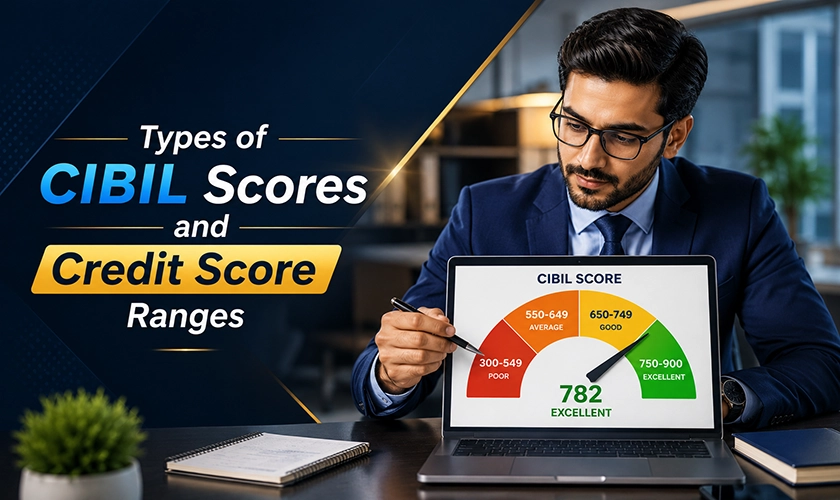
Your credit score reflects your credit management and repayment habits. Most people have this question in their minds: ‘What exactly is a good CIBIL score?” The answer lies in the credit score range system in India. Most banks and lenders consider 700+ to be a good credit score in India, though this system and range vary in every credit bureau.
The major credit bureaus in India are CIBIL,
Experian India, Equifax India, and CRIF High Mark. Read this article to gain
in-depth knowledge of the credit range and rating system in India.
What is a Credit Score and the Types of Credit Score in India?
A credit score is a 3-digit number that helps a lender make a lending decision based on a user's creditworthiness. Types of credit scores vary among major credit bureaus like Experian, Equifax, and CIBIL. The CIBIL score range goes from 300 to 900, and this range is consistent across major types of credit score in each bureau.
Your credit score is based on your
transaction history, credit utilisation ratio, old and new cards, and credit
mix. Taking credit actually builds your credit score if you repay it within the
agreed terms.
CIBIL Score
This is the most common type of Credit Score
used in India. It is called the Credit Information Bureau of India Limited. It
ranges from 300 to 900, with 600 being a poor score, 700 being a good credit
score, and above 750 being an excellent score.
CIBIL also releases Credit Information
Reports, Credit Commercial Report, customer acquisition analytics, and
portfolio management.
Experian
Experian India Pvt. Ltd. has been working in
India since August 2010. In February 2005, it was the first types of Credit
Score and company to receive the full RBI licence under the CICRA Act 2005. It
provides decision analytics, Commercial Reports, credit alerts, and free credit
score checks.
Equifax
Equifax India is headquartered in Mumbai and
registered as Equifax Credit Information Services Private Limited (ECIS). It
provides the Credit Information Report, risk and fraud management, credit
insights, etc.
CRIF High Mark
CRIF
High Mark is a credit bureau operating in India and licensed by the
RBI. It generates credit reports and personal and business credit scores. It was licensed in
2010 by the RBI and began working in 2007 as High Credit Information Services
Private Limited.
Credit Score range: A breakdown
Credit scores are evaluated on a scale: excellent, good, fair, poor, and rare. Refer to the chart of credit score range below for a clearer idea of how CICs assigns scores.
|
Credit
Score |
Tier |
|
800-900 |
This is the
rarest credit score range, taking years and decades of practice and
discipline to achieve. |
|
750-799 |
This is the
excellent credit score range, which enjoys top priority and most benefits
from the credit card companies, lenders and banks. This range demonstrates
good repayment habits and financial discipline. |
|
670-739 |
This is
considered a good credit score range, which positions you as a low-risk
borrower and lets you enjoy some of the benefits given by credit card
companies and lenders. |
|
580-669 |
This is the
fair tier of the Credit Score range, which shows you as a moderate-risk
borrower. This is a sign of past credit issues, such as late payments or high
credit usage. |
|
<580 |
This is the
poor Credit score range with the highest risk for lenders. This reduces your
approval odds and leaves you with higher interest rates and fewer options.
One should think of improving their score for a secure financial future. |
What are Credit Ratings?
Credit ratings are tools to evaluate the creditworthiness of business, corporate and financial organisations. These ratings range from AAA to D. These entities can be either of the following:
● Government
entities
● Corporate
companies
● Financial
companies
● Insurance
companies
● Private or public companies
Credit rating agencies are not the same as credit bureaus. They have different grading systems and work independently of credit bureaus. Thye are regulated under the Securities and Exchange Board of India (SEBI), under SEBI Regulations, 1999.
● Credit Analysis
and Research
● Credit Rating
Information Services of India
● Infomerics
Valuation and Rating
What are credit scoring models?
These models are mathematical formulas used to define your creditworthiness and repayment behaviour. This is useful for lenders to determine how likely a borrower is to repay on time after taking a loan.
FICO
The most common scoring models are FICO score
and VantageScore. FICO score comes from the Fair Isaac Company and is
considered the most reliable scoring model since 1989. It uses a range from 300
to 850, and below 600 is classified as a poor credit range. The latest update was FICO 10, but it is
expensive to upgrade for lenders.
VantageScore
VantageScore has been around since 2006 and is a more inclusive scoring model to compete with the FICO model. It is a more uniform formula which is consistent for data in all bureaus. Before it was introduced, credit bureaus could use their own calculations, causing inconsistent reports for the same data. One difference is that unlike FICO, which requires 6 months to generate the first credit score, VantageScore can evaluate thin files within the first month. Weightage percentage of factors in the VantageScore for your credit score range are:
● Payment
History: 40%
● Credit
Age and Credit Mix: 21%
● Credit
Utilisation: 20%
● Total
debt balance: 11%
● New
open accounts and other behaviour: 5%
● Available
credit (Credit limit-current balance=available credit): 3%
Weightage of factors in credit score range
The scoring model and evaluation formulas
differ in each credit bureau or types of credit score, but the core factors
remain the same in all credit reports: Experian, Equifax, CIBIL. Although the
weightage percentages may be irregular, the following are the main core factors
and their accepted percentage, as per the FICO model. TransUnion, Equifax, and Experian use the
FICO model.
Payment history (35%)
Payment history has the greatest impact on the calculation of your credit score. Timely payments mean that you are dependable and trustworthy to lenders. However, failure to make timely payments, late payments, defaults on loans, and other such problems may have an adverse effect on your credit score, and you may be in a lower credit tier as a result.
Good repayment practices will help you to
keep your credit score safe and improve your financial reputation as well.
Total Debt (30%)
It represents your present revolving credit,
which includes balances on credit cards. It shows how effectively you handle
payments and credits as a whole. An important factor here is your Credit
Utilisation Ratio (CUR), which is better to maintain below 30% to not seem like
a “credit hungry” person.
Credit Age (15%)
Your credit history age shows how much
experience you have with credit. The lender evaluates the average age of your
accounts, which includes your oldest, newest and even closed accounts. It is good
to keep old credit cards, as it increases your credit history age and helps
your reputation.
New credit (10%)
Frequent opening of accounts reduces your
score, as each time you open an account it makes a hard inquiry. Opening
several accounts at once can negatively affect your reputation by showing your
financial insecurity. Be careful with opening new accounts.
Credit Mix (10%)
A balanced mix of various types of credit is
a positive point in your profile, which helps you to show the lender that you
know how to handle different types of responsibilities. Excessive dependence on
only one type of credit is not a good choice for your credit profile.
Conclusion
It is important to know about credit scores, bureaus, credit score range and scoring models in India for financial literacy. A credit score range reflects a very important aspect of our lives, judging not only our creditworthiness but also our financial skills and behaviour.
By knowing about the mathematical formulas used by models and bureaus to calculate the credit score range, a user can get a better picture of the credit world. They get clarity on lender decisions and long-term planning for financial decision-making and mathematical calculations.
Major credit bureaus have a scoring range of 300 to 900, with 750 being an excellent score. While you can maintain a good credit score, it is important to remember that credit scores can fluctuate throughout life. It depends on your financial conditions, setbacks or successes, and even EMI payments that you didn't set reminders for. A user can resort to frequent credit score checks and implement practices that improve their credit score.
FAQs
1. What is the good credit score range?
In India, a good credit score ranges from 700
to 749. These scores make you eligible for loans and pre-approved offers.
2. What is a fair credit score
range?
A fair
credit score falls in the 580 to 650 range in FICO models and 600 to 660 in
VantageScore models.
3. How to check CIBIL score
range?
You can get your free CIBIL score report from
the CIBIL
website.
● Go
to the free portal on the CIBIL website.
● Enter
personal details and identity documents.
● Enter
the OTP and view the dashboard with the CIBIL report.
4. What are Credit Ratings?
Credit ratings are tools to evaluate the creditworthiness of business, corporate and financial organisations. These ratings range from AAA to D.
5. Is my credit score the same
in all credit bureaus?
No you credit score is different in all
bureaus even with the same data. It is because they use diverse mathematical
formulas, scoring models, and evaluation criteria. On top of it, not all lenders
report to every single bureau in India.
6. How long does it take to get
a 500 to 700 credit score?
This is a huge achievement to transition from
the lowest to a good score. It may take anywhere between six months and one
year for this milestone. It depends on the severity of delinquencies on your
low credit score. Serious defaults and bankruptcies can take the most time to
recover.