

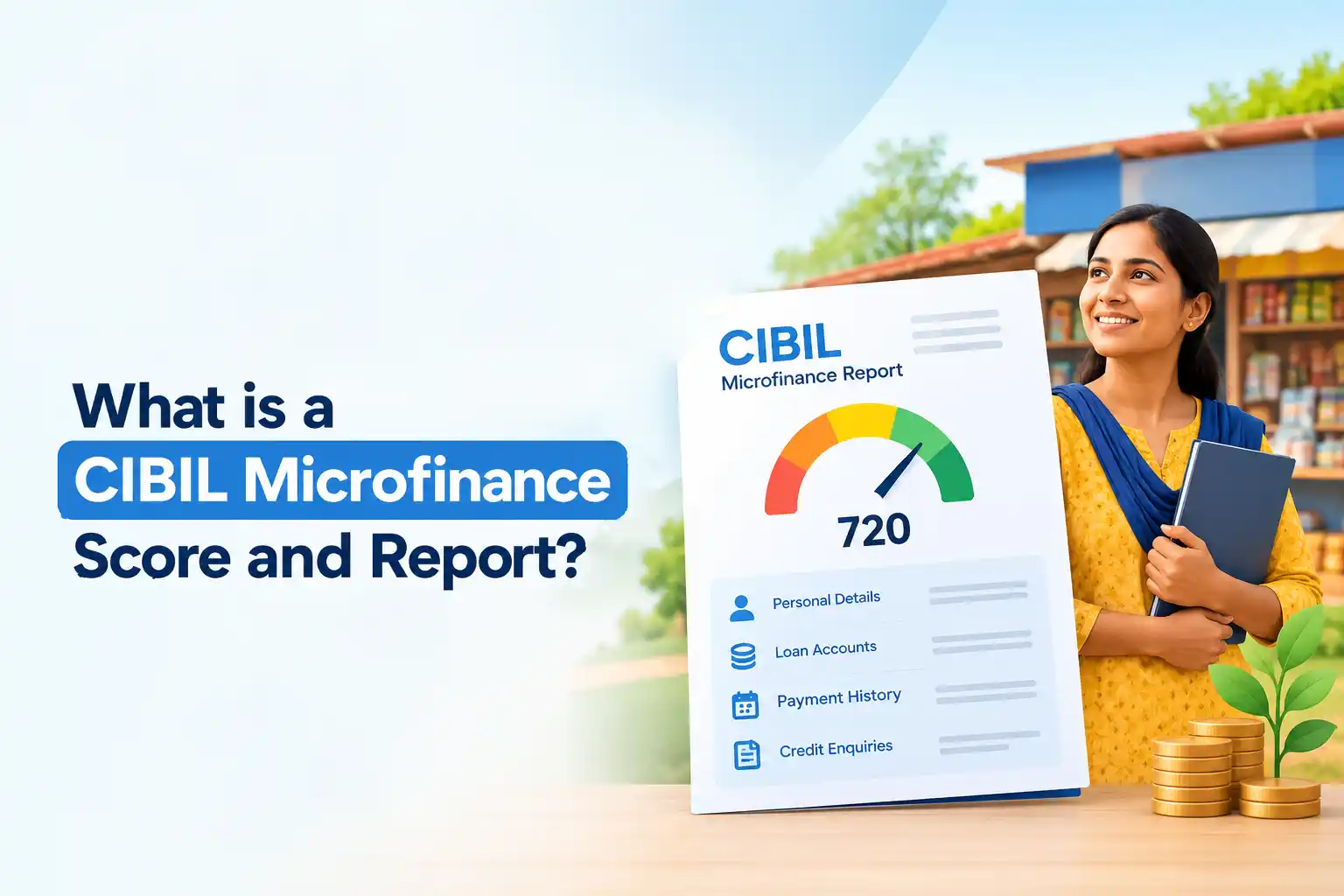
In today's financial landscape, we commonly associate the CIBIL score with credit cards and personal loans. But have you ever wondered about people who don't have access to these restrictive financial products? How do they define and evaluate their creditworthiness? There are many people in India who don't meet basic thresholds and requirements for a typical bank loan or credit card application. These include a steady income, minimum monthly income, credit history, and formal employment. Nevertheless, even this group of people, mostly rural, requires small-ticket loans at some points in their lives.
This is where the CIBIL Microfinance Score comes in, separating these groups from the formal credit ecosystem.
Low-income business owners can’t access traditional financial products. This is because there is no guarantee that they will be able to repay that amount or provide proof of source that meets the repayment requirements. They also support women, rural households, and small businesses to become independent without strict collateral requirements.
But this is not all—these loans and these financial systems require a specialised credit approach and scoring model. This is governed by the CIBIL Microfinance Score and CIBIL Microfinance report. It is different from a standard credit report because it is tailored specifically for the joint liability groups, self-help groups, and microcredit borrowing histories.
Why and how is CIBIL Microfinance different from regular CIBIL?
A standard CIBIL score is designed for people who participate in the formal credit system through traditional financial products. These include mainstream or big-ticket offerings like home loans, credit cards, business loans, personal loans, and auto loans.
However, the majority of low-income individuals are not privileged enough to use a credit card or avail a big-ticket loan. These people earn below the minimum threshold and face a scarcity of jobs. Their credit behavior is reflected through small-ticket loans up to 1 lakh rupees by MFIs, peer-to-peer lending, self-help groups, NBFCs, and rural lending programmes. They do not evaluate repayment capacity but focus on group lending dynamics.
There is another fundamental difference that concerns the way lending is performed. Unlike traditional lending, micro-lending does not require collateral and can take place not only with an individual but with a group of people as well. Joint liability groups act as guarantors of repayment in this case, which makes them quite different from usual loans.
Unlike the traditional CIBIL score that varies between 300 and 900, the CIBIL microfinance score is calculated based on unique data related to the micro-loan behavior of the borrowers.
Thus, lenders can make better lending
decisions and promote financial inclusion at the same time using the CIBIL
microfinance score.
What is Microfinance?
Microfinance is described as the provision of small financial services to poor individuals, families, and micro-entrepreneurs who are unable to access conventional banking services.
The concept of the CIBIL microfinance score arose as an answer to the financial divide between formal banking services and unserved groups. Such people often have no sufficient proof of income, are unable to provide any collateral, have no banking history, or are geographically separated.
Microfinance services include the following options:
●
Loans for small amounts
●
Microenterprise loans
●
Agricultural loans
●
Livelihood loans
●
Loans for groups
●
Small savings facilities
● Insurance services in some cases
The main goal of microfinance services is not only lending money but also developing financially and improving people's lives. The help provided through microfinance helps people to open and develop their small businesses, engage in agriculture, pay for education and healthcare expenses, and deal with household emergencies.
In India, the role of microfinance was especially large in empowering rural women. A lot of microfinance loans in India are granted through self-help groups (SHGs). In such SHGs, borrowers first save money and cultivate good credit discipline before obtaining big loans.
The development of CIBIL microfinance score in general, created the need for special systems of credit reporting to track borrower behavior. This led to the creation of microfinance credit bureaus and scoring models.
Significance of CIBIL Microfinance Score and Report
Encourages Responsible Lending
The CIBIL Microfinance report can be used by microfinance institutions to check whether the borrower has multiple existing loans. This will prevent over-lending and thus prevent borrowers from getting into debt traps. The repayment percentages for such institutions are quite good.
Assists in Creditworthiness Assessment
The CIBIL microfinance score can help to check
a person's creditworthiness even if there is no bank loan or credit card. This
is done by checking whether the person makes payments regularly. It provides a
comprehensive system to evaluate the risk profile of a low-income individual.
It facilitates risk management and business tailored to the riskiness of such
borrowers, distinct from traditional banking.
Financial Inclusion
The microfinance score gives an easy way of
evaluating such borrowers who would not be evaluated by formal financial
institutions or have any official records.
Prevents Borrowing Multiple Loans
A CIBIL microfinance report can be used by the lender to identify borrowers who might be borrowing loans at the same time from multiple MFIs. Overborrowing is one of the greatest risks in the microfinance industry.
CIBIL Microfinance
TransUnion CIBIL operates one of India’s
largest credit information systems along with a dedicated microfinance bureau.
It regulates and maintains information and records from participating
microfinance institutions, NBFCs, MFIs, small finance banks, cooperative
lending institutions, and other lenders in microcredit operations.
Borrower Identification Details
The section includes basic details like:
●
Name
●
Gender
●
Date of Birth
●
Address Details
●
Identification Numbers
● Loan Account Details
The CIBIL Microfinance report includes:
●
Microfinance loan accounts
●
Amounts of the loans
●
Dates of disbursements
●
Outstanding balances
●
Repayment details
●
Closed loan accounts
● Delinquent accounts
Any late payment or defaulted account is
included in the CIBIL microfinance report.
Borrowing Behaviour
The data helps lenders determine whether the borrower is borrowing prudently and has good repayment patterns.
The report helps lending agencies get an
accurate idea of borrower risk, especially for new borrowers and underserved
communities.
Equifax Microfinance
Equifax India has a microfinance database and offers specialized credit information services for lenders that operate in the rural and low-income lending markets.
Equifax collects borrower information from:
●
Microfinance Institutions
(MFIs)
●
Non-Banking Financial Companies
(NBFCs)
●
Small Finance Banks
●
Co-operative organizations
●
Other participating lenders
Loan Exposure
The report provides the total number of
existing loans and outstanding obligations of the borrower.
Repayment History
Repayment history is often an excellent and
primary indicator of future repayment behavior.
Debt Ratio
Lenders are able to see if the borrower has
already built up too much debt from several sources.
Risk Assessment
The report helps financial institutions in
identifying risky applications prior to lending.
Experian Microfinance
Experian aims to provide accurate data for evaluation to lenders of underserved consumers. These consumers' data are hard to find because of informal employment, low income, social marginalization, and self-employment.
It tracks credit history, detects multiple
lending relationships, monitors portfolios, and improves lending decisions.
CRIF Microfinance
CRIF, at the time of its inception, aimed to
collect information from the microfinance sector and generate accurate borrower
information for lenders. These reports have helped curb delinquency rates among
microfinance borrowers. CRIF released the first dedicated microfinance database
in March 2011, which grew to become the largest database of 80 million
borrowers.
Types of Microfinance Loans
Income Generation Loans
This is a common microfinance loan that helps borrowers start, expand, or manage businesses instead of personal needs:
●
Grocery shop financing
●
Tailoring businesses
●
Livestock farming
●
Handicraft production
● Food vending operations
These loans are aimed at generating regular
income to support family stability.
Agricultural Loans
Farmers require small-ticket loans for the following aids:
●
Purchasing seeds
●
Buying fertilisers
●
Irrigation expenses
●
Crop cultivation
●
Farm equipment
Emergency Loans
Unexpected circumstances can cause immediate financial needs. This financing can be used for:
●
Natural disaster support
●
Medical treatments
●
Family emergencies
Educational Support
MFIs can help rural people with:
●
School fees
●
College tuition
●
Study material and educational
resources
Housing improvement loans
Microfinance housing loans are meant for renovation and repair rather than large-scale purchases. They come with flexible income proof, small ticket sizes, and collateral-free structures.
●
Roof repairs
●
Kitchen extensions
●
Sanitation facilities
●
Electricity connections
●
Water connections
●
Random repairs
Women’s Entrepreneurship Loans
Many microfinance institutions specifically target women entrepreneurs to encourage financial independence and business ownership.
●
Home-based businesses
●
Retail activities
●
Food processing units
●
Cottage industries
Conclusion
The CIBIL Microfinance Score and Report play a crucial role in determining the financial status of borrowers functioning in the informal financial sector. The usual CIBIL score is calculated keeping in mind the common types of borrowing options, such as personal loans and credit cards. A CIBIL microfinance report is made to analyze the repayment behavior of less detectable low-income customers, rural borrowers, SHGs, and small entrepreneurs.
By obtaining information about borrowers’ transactions from microfinance organizations, NBFCs, small finance banks, and various lenders, credit bureaus such as TransUnion CIBIL, Equifax, Experian, and CRIF High Mark try to develop an inclusive financial environment where lenders are able to make better decisions, decrease default rates, avoid over-indebtedness, and provide formal finance to many borrowers in India.
Thus, a CIBIL microfinance score may become a
very good basis for further financial inclusion and obtaining bigger financial
services within the formal credit market.
FAQs
1. Who uses the CIBIL Microfinance report?
Microfinance institutions, NBFCs, small finance banks, cooperative lenders, and other financial institutions use these reports to evaluate borrowers based on accurate information about previously undetected borrowers in the traditional credit ecosystem.
2. Why is the CIBIL Microfinance report important for financial inclusion?
These reports help create a documented credit history for borrowers who may otherwise have no formal financial records. It motivates borrowers to be more financially responsible and provides them with an opportunity for development.
3. Are microfinance credit bureaus for farmers?
Yes, Microfinance credit bureaus and financial products are extensively used by and revolve around agricultural farmers. Traditional banks and credit settings evaluate bank histories, salaries, bank statements, and corporate information. On the other hand, microfinance credit bureaus evaluate low-income individuals who do not have traditional banking exposure. They also have higher interest rates than banks.
4. What challenges do microfinances face when scaling in India?
Microfinance institutions in India face structural, regulatory, and operational hurdles. Loan stacking is the process in which MFIs lend to the same borrower for “volume-driven growth”. This happens because a borrower borrows from multiple MFIs and SHGs in a chain of paying off debt, giving rise to non-performing assets. This can happen because of poor bureau reporting in certain regions, lack of knowledge of the true debt burden, and some institutions not reporting to bureaus.
They have operational costs and a huge administrative overload for thousands of small-ticket loans. Another concern is erosion of the Joint Liability Group model because one person is making up a larger portion of the lent funds, and one default leads to refusal of the rest of the group to pay. In fact, these people are more vulnerable to financial and circumstantial shocks like instability, climate risks, and political risks like loan waiver promises in state campaigns.
5. Why is the CIBIL score different from the microfinance CIBIL score?
The data scope in both bureaus is different and requires separate scoring models or algorithms. The latter also relies more on repayment history rather than immediate missed payments, as compared to the regular CIBIL score. It focuses on consistent repayment and group dynamics.
The proprietary scoring model used in MF CIBIL
analyses group dynamics, short-term cash flow patterns, and microloan
frequencies, which is distinct from the algorithms of the standard CIBIL. The
reporting cycles also vary compared to traditional banks and lenders. The scope
of credit mix is also narrower.