

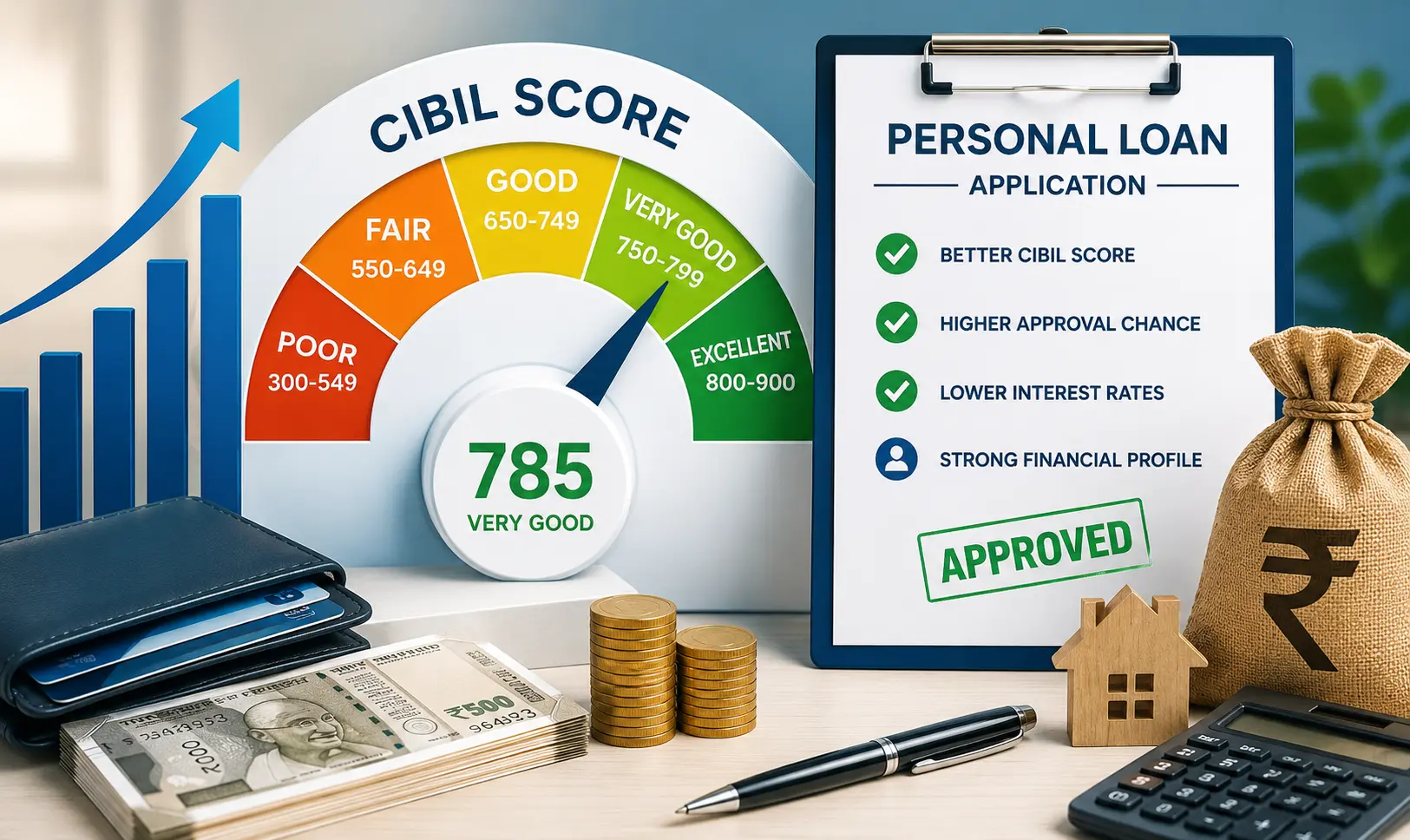
A CIBIL score is a small but powerful number.
A person may realize this when he applies for an important loan he wanted and
planned for years but gets rejected. But the question remains: what is the
ideal CIBIL score for personal loan? Read to find rare and valuable insights
about how CIBIL score affects Personal Loan processing in India.
What Is CIBIL Score For Personal Loan In India?
CIBIL score and report are three-digit numbers assigned to a borrower that determine his creditworthiness with lenders and banks. This means that banks use this number to determine how responsible the borrower is in paying back his loans. Read this blog about CIBIL Score to learn everything about the number.
What is the Required CIBIL Score for Personal Loan?
A CIBIL check is the primary filter for banks when approving a personal loan. A strong 750+ CIBIL Score for personal loan is considered healthy. While smaller financial institutions may even approve at a 650 point, you might get higher interest and tenure, complicated bank processes, and even face rejection. Even though it is not the sole factor, it is a defining factor and might even help you bag pre-approved loans.
CIBIL Score Range In Detail
Refer to the table below for a clear outline of the CIBIL score range and what response you can expect from the bank.
|
CIBIL Score |
What To
Expect |
Terms Agreed
On |
|
750-900 |
Fast
processing, pre-approval |
Lowest
interest, higher limits |
|
700-749 |
More chances
of approval |
Competitive
interests, average limits |
|
650-699 |
Selected
banks and fintechs |
Higher
interest rates, need for assisting factors |
|
<650 |
Expect
rejection or need for a co-applicant |
Expensive |
Important Bank Checks Beyond CIBIL Score
Many loan applicants make the mistake of overlooking these points and assuming CIBIL Score is the sole decisive factor in Loan Approval. By reading and following these guidelines, you can avoid making the same mistake as others.
● The EMI-to-income ratio is very important. Many banks will not give a loan to people whose total EMIs are more than forty to fifty percent of their net income. This is true even if your CIBIL score for personal loan is good. So if you can lower your existing EMIs, it can make a difference.
● The bank will also look at your account history and statement. They will check the six to twelve months of your bank statements to see how you get your salary, how much cash you withdraw, and if you have taken any overdrafts. If your income is not regular or if you take overdrafts often, it can reduce your chances of getting a loan. Therefore, revising your account seasoning is a good decision.
● It is also important to know the difference between a settled account and a closed account. If you have settled a loan, it creates a bad impression on the bank because you didn’t pay the full amount. On the other hand, a closed loan is better. So, you should always get a No Objection Certificate and make sure your loan status is updated. This can help you get a loan faster.
● Economic
Stability and only one hard inquiry are ideal
for the bank to trust you, as they also put caps on what percentage of your
monthly income you can use as installments. Instead of applying to multiple
lenders, request a soft eligibility tool to avoid CIBIL score-dropping hard
pulls.
Which Bank Should You Apply For a Personal Loan?
|
Bank |
Accepted
CIBIL threshold |
What You Are
Offered |
|
State Bank
of India (SBI) |
700-750 |
Best
interest rates for 750+ |
|
HDFC Bank |
700-750 |
Competitive
offers, stricter checks |
|
ICICI Bank |
700-750 |
Faster for
750+, higher rates below |
|
Axis Bank |
700-750 |
Particular
for lower than 700 |
|
Kotak
Mahindra Bank |
700-750 |
Best for
750, higher rates below |
|
IDFC First
Bank |
675-725 |
Conditional
acceptances |
|
Bajaj
Finserv (NBFC) |
650-725 |
Approval for
higher interests |
|
Tata Capital
(other NBFCs) |
650-725 |
Accepts the
650 band |
|
Small
Fintechs |
600-650
(varies per case) |
Possible but
expensive and conditional |
Why Is a Good CIBIL Score Recommended For A Personal Loan?
●
Faster Approvals:
Banks process approvals faster, have easier documentation, and even provide
pre-approved loans.
● Lower
Interest: Interest makes up the most of the
repayment amount. Banks grant the lowest interest rates to borrowers with
high credit scores. Even a 0.5 difference in interest rate can amount to a lot
of money over years.
● Enjoy
flexibility and larger limits: You get offered desired
tenures and larger credit or loan amounts compared to lower credit scores.
● Premium
Rewards: The 700-and-above threshold instantly unlocks
exclusive rewards and offers for you.
How Can I Get A Personal Loan For CIBIL Score of 650?
You urgently require an important loan for emergency—butbut your CIBIL Score Report says otherwise. You definitely don’t have time to improve your CIBIL Score for Personal Loan. What should be your action plan for a personal loan for low CIBIL Score? Read to avoid costly mistakes.
- Secured Loan against Fixed Deposit or Gold
If you didn’t already build trust with your bank, a secured loan and FD amount acts as a bridge. You might qualify for a comparably lower interest rate, less dependency on your credit score, and no more slow processing.
- Loan with a Co-Applicant
This method includes your co-applicant’s income and credit to improve your chances. The joint application looks less risky to the lender when you really need better odds at your disbursal. This is a method that balances your credit report, prioritising your co-applicant’s creditworthiness for evaluation.
- Fintech or NBFC route
You can opt for the fintechs or smaller institutions that accept lower CIBIL bands, although you have to pay higher interest rates for them. Check your financial robustness to be able to pay those rates. These institutions check other factors of creditworthiness– like transaction history, bank statements, and employment details.
|
Salary bank |
Salary is a
metric used by banks for stability. |
Relaxes the
threshold for credit scores and considers your case for approval using other
securities like your employment and income history. |
|
Fintechs and
NBFCs |
Bajaj,
Finserv, Fullerton, Mahindra Finance, IDFC First, TATA Capital, KreditBee,
Navi |
Grants a
loan for a lower score but requires higher interest rates and other charges. |
|
NBFCs and
major banks |
Gold Loans
and FD Backed Loans |
Collateral
reduces scrutiny; credit score is not important when you have a fixed deposit
or gold deposit for security. |
What You Should Do Immediately Before Applying for a Personal Loan
Since we all know that loan disbursal is a complicated process backed by scrutiny and lengthy paperwork, you should refer to a foolproof action plan to improve your application process with the bank.
1. Review And Clean Up Your Credit Profile
Get a copy of your CIBIL report and review it closely for any errors, any accounts you don’t recognize, or accounts that have been reported to the credit bureau late by the creditor for an account that you paid on time.
You should dispute any inaccuracies with the bureau right away and follow up with them until they are corrected.
How to improve your CIBIL Score for Personal Loan: keep credit card balances low enough to have an average credit usage below 30% (use the payment calculator to determine this), close unused cards only if they will not shorten the average age of your accounts by a lot, and do not apply for any other credit accounts for 2-3 months before applying.
2. Request closure
Request an NOC for all closed accounts, and get closure for previous settlements. Pay up your previous EMIs so that the banks don’t have anything that catches their eye.
3. Determine Affordability and FOIR
To determine your FOIR or EMI to income ratio, add your proposed EMI to your existing EMI amounts and divide the total amount by your Net Monthly Income. Your FOIR calculation will typically be higher than the bank’s average of 40%-50%, resulting in rejection of the loan application at some point in the process.
If your FOIR is high, you can decrease your existing EMIs, increase the term of your loan (however, your total interest amount will increase), or add a co-applicant at the time of submitting your loan application.
4. Utilize Soft Qualification Tools and Lenders
Use Soft Qualification Screening on Bank/Fintech Lenders Portals to find pre-approved offers without affecting your CIBIL score, as well as a lender for which you have an existing relationship (i.e., banking relationship, Salary Account, Savings Account, FD’s) who will typically provide quicker approval, lower cost, and a better chance of accessing funds at that institution. Always go for soft inquiries to avoid hard pulls; only request a hard pull when you finalise a bank for your personal loan. An extra hard pull can instantly lower your CIBIL Score by up to 10 points.
6. Secured vs. Unsecured Loans and Co-Applicant
If you are concerned about poor credit issues, then a Secured Loan (FD backed or Gold backed) or using a Co-Applicant will have a better chance of being approved for a loan, and each has its own risk to borrow against your collateral and its own documentation requirements.
Finally, remember to ask your banks whether
they report your loan details to the credit bureaus or not. Loans are a
great way to improve your creditworthiness, and your loan details must be
included in your CIBIL report.
Conclusion
Managing your credit and papers before approaching a bank for a personal loan in India is a smart practice that improves your personal odds. A well-informed individual and a credit report that reflects your sincerity can help you achieve your desired personal loan.
FAQs
Can I get a loan approval for a 600 CIBIL score?
Yes, you might be approved for a loan with a 600 credit score for higher interest rates, but your chances are not guaranteed. You might approach NBFCs or fintechs like Bajaj Finserv and Tata Capital, or you can apply for secured loans or co-applicants with a similar CIBIL score for Personal Loan.
1. What is FOIR?
Fixed Obligation to Income Ratio, or FOIR, is a threshold banks use to determine a loan applicant’s creditworthiness. It is a metric that determines your potential to pay for additional loans while already having previous debts or EMIs. Banks use a specific mathematical formula for calculating FOIR.
2. How Can I Maximise My Loan Approval Chances?
These are some important checks that many people tend to avoid due to a lack of knowledge.
● Seasoning means keeping your regular salary deposits and other inflows in a bank account for 3-6 months. This creates predictable cash flow, which is appealing to lenders.
● Consider starting with a small secured product such as a short-term FD-backed loan or a consumer durable loan. These products can help to build a recent positive payment history quickly if you repay them on time.
● Do not close old accounts at or near the time you apply for a loan; average account age is a consideration of lenders.
● Where possible, seek a co-applicant with a stable income rather than a guarantor. Co-applicant income counts toward the Fixed Obligation to Income Ratio (FOIR), which lowers the risk of rejection.
3. How often do I check my CIBIL Report?
Ideally, you shouldn't check it too often, only once every 3 to 6 months. If you are actively looking for a loan, check your CIBIL Score for personal loan every month. However, when lenders check, it deteriorates your score, because it stands as a hard inquiry.
4. Can my loan be rejected even at 750+ credit?
Your CIBIL Score for personal loan is one of many variables that lenders review prior to offering you a loan. If your score is over 750, this demonstrates an established pattern of repaying your debt; however, this does not always indicate current affordability, as well as meet all required documentation or lender policies.
- Affordability will ultimately determine whether or not you will receive loan approval. Lenders determine your fixed obligation-to-income percentage.
- If there have been employment changes within the last 12 months, or you have held your job for less than two years, or you have not filed your taxes consistently, you will appear to be a higher risk to the lender and may be rejected.
- If your salary is credited irregularly, you have several overdrafts or returned transactions due to insufficient funds, or you have unusual deposits, it may affect your ability to obtain a loan.
- Lenders view high credit utilization and multiple recent inquiries as indicators of financial stress.
If you have incomplete or inconsistent documentation, your application is likely to be declined for operational reasons.