

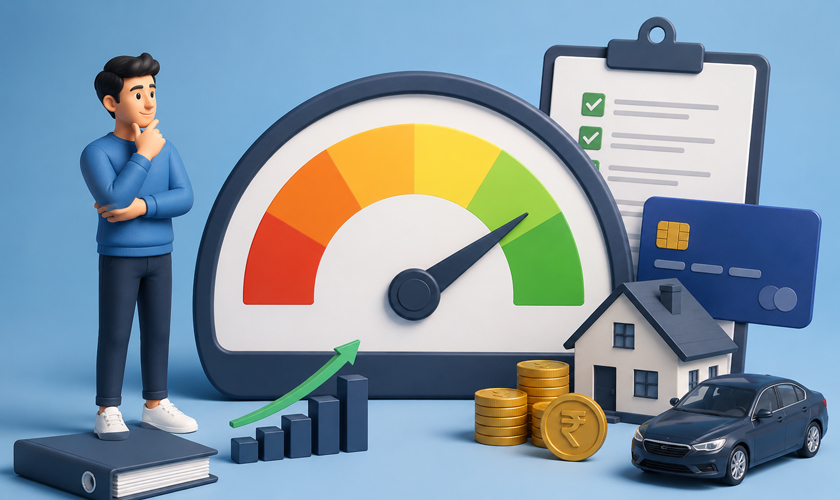
The 3-digit number that represents an individual's creditworthiness is called a “CIBIL Score." Basically, there is a score range between 300 and 900. Before moving further, let us understand what is CIBIL Score is in detail below.
What is CIBIL
score?
As stated above, a credit score is basically a 3-digit number that ranges between 300 and 900 and represents the individuals creditworthiness. Also, the CIBIL score is like a financial report card that helps lenders know the people's responsibility towards their credit. Hence, it can be said that CIBIL Score is a trust score for creditworthiness.
The trust is built only when the person borrows money and repays it on time. Making the payment on time increases the creditor's trust. Then this trust is reflected in the CIBIL score, which ranges from 300 to 900. Hence, you should know that the higher the score, the more they appear to lenders. So, above was the information regarding what is CIBIL Score. Now, let us learn more about the CIBIL score.
Importance of CIBIL score
The facts behind the CIBIL score are important because they act as evidence when applying for financial assistance. Therefore, the importance of CIBIL score is mentioned below:
- When calculating your CIBIL score, your credit history is taken into account. For this computation, CIBIL employs an owner algorithm.
- However, how you have previously handled credit, including loans and credit card bills, is the most crucial factor in this computation.
- Because it enables banks to only grant credit cards and loans to individuals with a solid credit history, the CIBIL score is crucial.
- Giving credit to someone who has a high credit score enables them to guarantee that the credit is given to someone who manages credit responsibly.
- Compared to lending money to someone with a bad credit history who might not pay it back on time, this enables them to be less of a credit risk.
How CIBIL score
works?
Now that we’ve discussed the importance of CIBIL score, it is time to understand how CIBIL score works. The CIBIL score isn't fixed. It is constantly changing depending on the individual's credit history and performance. Here are the four factors on how CIBIL score works:
- Payment History: A person's CIBIL score decreases if they regularly miss loan and EMI payments or fail to make them on time.
- Credit Mix: The CIBIL score will stay positive if the applicant has a balanced mix of secured and unsecured loans. Credit card bills and personal loans are examples of unsecured loans, whereas secured loans include home loans, auto loans, and so forth.
- Loan Inquiries: The score may suffer if the report contains several credit or loan rejections. In a similar vein, if a person has recently taken out several loans, their debt load will increase, which will lower their credit score and warn lenders not to grant them any more loans.
- Credit Utilization: A person's CIBIL score is negatively impacted by higher credit card balance usage, which indicates a higher level of debt.
CIBIL updates each person's score by evaluating all these factors each month. Therefore, the lender will evaluate the applicant's most recent CIBIL score and report during the loan application process to determine their financial credibility. The loan will be approved quickly if they meet the requirements. If not, the interest rate will go up, or the application will be denied.
Why CIBIL score matters?
When applying for a loan, the CIBIL score is very important. When someone applies for a loan at a bank or other financial institution, the lender first looks up the applicant's reports and CIBIL score. The bank might not even take the application into consideration if the CIBIL score is low. The lender will review the application and take other factors into account if the CIBIL score is high in order to assess the applicant's creditworthiness.
For the lender, the CIBIL score serves as a first impression. Your chances of having the loan reviewed and approved increase with your score. CIBIL does not in any way determine whether or not a loan or credit card should be approved; the decision to lend is entirely up to the bank. A score of 700 is generally regarded as good.
Why Does It
Matter?
Making significant financial decisions requires having
a high credit score. There are various benefits to having a high credit score.
Also, the information regarding why does CIBIL score matters are in the details
below:- Credit scores are used by lenders to determine whether borrowers are eligible for credit cards and loans.
- Loan applicants with high CIBIL scores are eligible for competitive interest rates.
- Additionally, they are more likely to be approved for both secured and unsecured loans.
- Lenders can provide better terms for credit cards, auto loans, personal loans, and home loans when borrowers have higher credit scores.
- Higher credit limits may be available to those with high CIBIL scores.
You can better manage your finances and enhance your financial prospects with a high credit score.
What is the Good
CIBIL Score Range?
Now that we know the fundamentals of CIBIL, the range of good scores makes sense. Typically, the CIBIL score ranges from 300 to 900. Various ranges correspond to varying creditworthiness levels. The following CIBIL score range classification is widely used:
- 300 to 549: Low credit rating
- 550 to 649: Fair credit score
- 650 to 749: A good credit score is between
- 750 to 900: A strong or excellent credit score
Wrapping Up
There is more to a high CIBIL score than just a figure. Your creditworthiness and financial discipline are reflected in it. In addition to increasing your chances of getting a loan, keeping your score above 750 gives you access to better financial products, lower interest rates, and higher credit limits.
Consistent practices like timely bill payment, low credit utilization, debt reduction, and routine credit report monitoring are crucial. You can create long-term financial stability and open up more growth prospects with prudent credit management.
Frequently Asked Questions
1. What
is the purpose of CIBIL score?
The purpose of the CIBIL Score is to give the first impression of the financial status. Hence, a CIBIL score reflects your repayment history and creditworthiness.
2. Is
a CIBIL score of 700 to 750 good?
Yes, 700 to 750 is a good CIBIL score, as it can give access to better financial products. It can help in lowering the interest rates and also provide access to higher credit limits.
3. What
is a good CIBIL score?
700 to 900 is a good range for a CIBIL score. Usually, lenders require a score of 750. It is actually possible to have a score between 650 and 699, but you will probably have to deal with more stringent terms or high interest rates.
4. What
is meant by CIBIL score?
A
credit score is basically a 3-digit number that ranges between 300 and 900 and
represents the individual's creditworthiness. It helps the borrowers to
understand the financial status of the lenders.