

A
credit score is very important for our lives’ decisions. It is a support system
for those in an emergency or who want to buy a property or car. A good credit
score in India helps a customer secure a loan with favourable terms for
interest and duration. These decisions are among the biggest decisions in a
working person’s life. Just as planning largely affects the execution of such
decisions, a misinformed action can make a negative impact. These can be
difficult to resolve and damage your credit score for a longer period of time.
Many people in India and around the world still let these credit score myths weaken their reason. These can be risky because a single mistake can unintentionally drop your credit score. On top of that, you will be unaware of it. Neither will you be able to progress with this incomplete knowledge, nor will you be able to maintain your credit score.
Here goes the idiom: ‘No knowledge is better than little knowledge.' Since you don’t know what’s wrong or which one of your practices is actually one of the credit score myths, the damage can be prolonged.
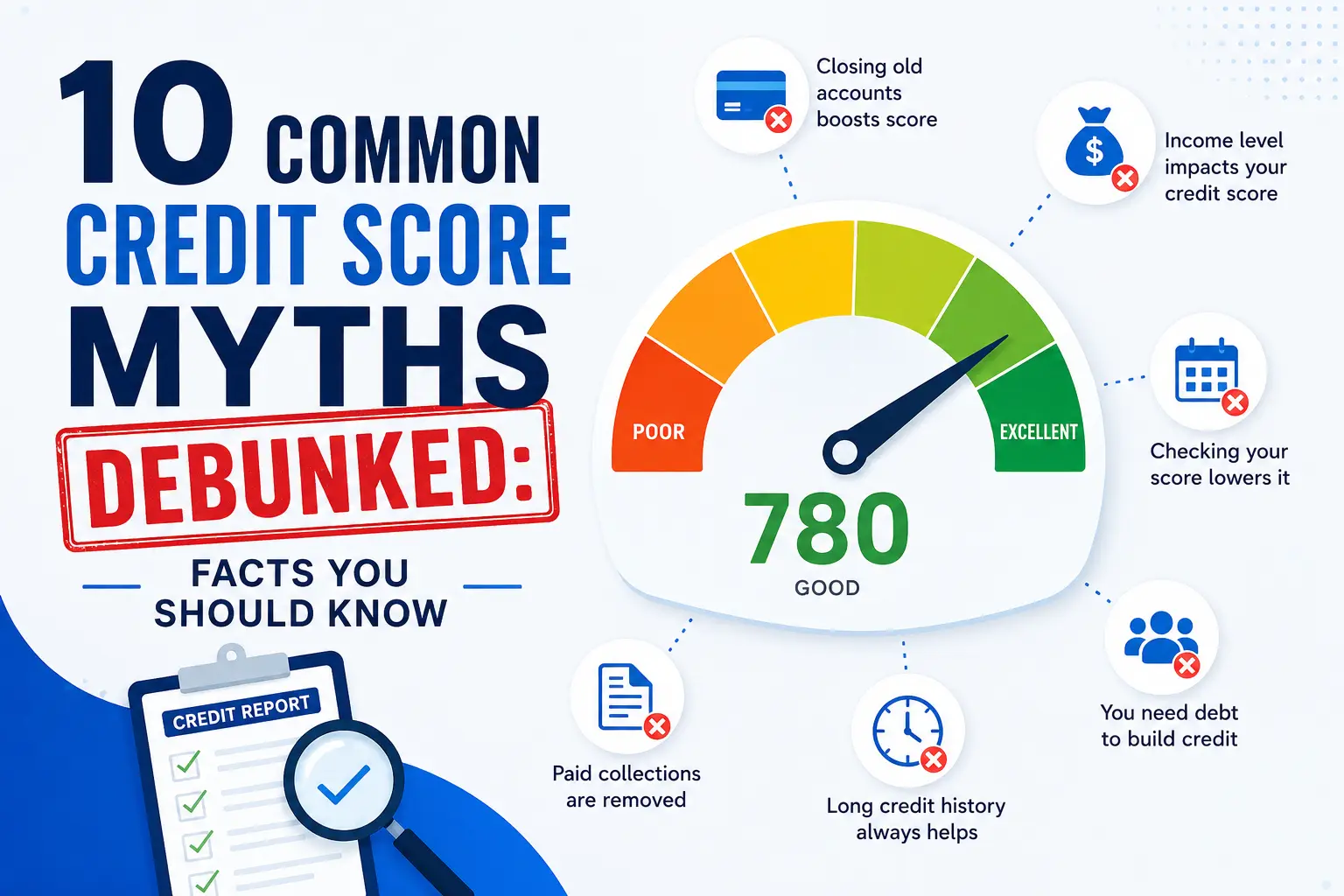
10 Biggest Myths About Credit Score Debunked
It is easy to make assumptions and believe in credit score myths. This is possible despite knowing plenty about it. It is because a good credit score range is a disciplinary calculation rather than based on numbers.
1. Checking your credit score lowers it
One of the credit score myths is that all kinds of inquiries are harmful to your credit report. What they need to understand is the difference between a hard and soft inquiry.
● A soft inquiry is the credit check that you conduct yourself to monitor any changes and new activity.
● A hard inquiry is the credit check that other organisations conduct when you apply for credit.
A hard inquiry can drop your credit score. A soft inquiry is a good financial practice that you can pull as many times as you please. Check your Free Credit Score and Credit Report today.
Why it Damages Your Credit Score
Confusing soft inquiries with hard inquiries can form fear in people’s minds. This will prevent them from monitoring their credit report regularly. They will become more prone to identity theft, errors, duplicates and fraud in their credit report. They might even stay unaware of these events for longer periods. This can cause prolonged damage to their now good credit score.
2. You need to have a balance at all times to build and maintain credit
Carrying a balance at all times can negatively impact your score by pushing it further down. If you carry outstanding balances, it will increase your compound interest. Instead of having a balance, be active in both taking and repaying credit. This is the best practice to build and improve your credit score by using the repayment aspect.
Why it Damages Your Credit Score
Piling up debts can increase your credit utilisation ratio. This can indicate financial stress and struggle with multiple debts. Missed payments or defaults can also be counted and will stay in your report for longer. All these aspects will individually lower your credit score by a few points.
3. Having multiple types of debts decreases your score
Many people feel like multiple types of debts can be burdensome. Multiple types of credit cards and loans will be difficult to manage and pay back. The truth is, a healthy credit mix of EMIs, secured and unsecured loans is really beneficial for a credit score uplift.
Why it Damages Your Credit Score
The people who believe this myth intentionally refrain from creating a credit mix. Not only does shying from a credit mix stall your credit score growth, but it also portrays you as high-risk to lenders and banks. Such credit score myths will negatively affect your financial actions.
4. Taking small or no credit
helps your score
Many people believe that taking large amounts of loans will cause a credit score drop. A small credit or loan is always manageable and more affordable to repay compared to a bigger loan. These credits have very little contribution to the payment history and show a lack of credit mix. These can also invite hard inquiries on your credit profile.
Why it Damages Your Credit Score
5. Making minimum but early EMIs improves your credit score.
Many people falsely think that all they need to do is make regular or early payments every month. Therefore, they end up making only the minimum payment thresholds each month, while the debt is still not closed. The point is to make full payments as frequently as you can. Otherwise, minimum payments will not be counted as positive repayment behaviour.
Why it Damages Your Credit Score
This habit will keep your due balance and CUR high, indicating financial trouble. This is costly and also results in a poor credit score.
6. Closing accounts can improve my credit score.
It is a credit score myth that closing down old credit cards or fully paid accounts will increase your credit score. It will be easier to manage with fewer credit cards. But the truth is, it will damage your credit score.
Why It Damages Your Credit Score
It will remove the old account history for assessment by lenders and banks. It will also remove any additional credit limit that was added to the overall credit limit. This will decrease your overall credit limit and negatively impact your current payments. You might end up with a poor credit score without your knowledge.
7. I have only one credit score
There is a common credit myth that a person can have only one credit score. But the truth is, each person can have different scores, depending on the scoring model. There are CIBIL, Experian, Equifax, and scoring models like FICO and VantageScore. This is very common in foreign countries where every person has different credit scores.
Why It Damages Your Credit Score
Monitoring differs for each bureau and scoring model because each is very different from the others. Bureau-specific errors are to be addressed differently.
8. Your score signifies how rich
you are
Many people think that having a good credit score in India means that you are rich. This is a false claim. A rich person can have a lower credit score than a poor person. Income can affect a person’s credit card limit, but not the growth of a credit score.
Why It Damages Your Credit Score
Income is not a scoring factor, and having this assumption can lead to carelessness in borrowing for those who are wealthier.
9. Once I have a poor credit score, it can not be increased
One of the credit score myths is that credit scores are permanent. Once they have a poor score, it will always be in the lower range. They will not be eligible for favourable loans and other financial facilities.
Why It Damages Your Credit Score
Believing so will discourage people from adopting credit score improvement practices. To escape the low CIBIL score trap, lower credit usage, make on-time repayments, and fix errors by filing a dispute.
10. Paying off your debt will immediately lift your score.
There is an assumption that paying off debt is a positive credit behaviour, and it will immediately remove the debt. However, credit bureaus take about 30 to 45 days to update new information.
Therefore, no information is updated immediately, as banks and lenders take about a month to send new information to credit bureaus. Also, paying off your debt doesn’t necessarily increase your credit score. It might remove the delinquency, interest, and negative impact on your credit score.
Why It Damages Your Credit Score
Late payments and defaults stay in the credit report for a long time. Expecting instant changes can lead to confusion, discouragement, and frustration.
Other Common Credit Score Myths and Facts You Might Not Know
There are several other unaddressed credit score myths of lesser importance. Read further to find out if you believed in one of them!
Only a credit repair agency can recover your credit.
People approach a credit repair agency in times of stress, dilemma, and lack of time. However, the truth is they release research reports and help you find weak points that you can rectify yourself. There is nothing that a credit repair agency does that you can’t. Although, from a different perspective, you can use the services of a reputed credit consultancy like NS Credit in other ways.
● If you don’t have time,
● you want professional assistance to legally solve a dispute,
● you want assistance in building strategy from experience.
● You want specific results in a desired amount.
● Or you can’t seem to find a specific weak point to work on; you can choose this option.
Why It Damages Your Credit Score
Believing that credit repair agencies can completely erase old negative history is a waste of time and energy. If you know how to fix your credit score, you can also do it yourself.
Anyone can check my credit score
It
is one of the common credit score myths that people believe. That anyone on the
internet can randomly access and study their credit report. This is false, as
Indian law doesn’t allow private information to be publicly accessed. Only
lenders, financial institutions, or others with permission can pull a hard
inquiry on your credit profile.
Why It Damages Your Credit Score
It can be serious misinformation and cause fear and uncertainty about private financial information.
A score lower than 750 can't be approved for a loan.
Some people actively consider the minimum credit score for a personal loan to be 750. Although banks favour this score and receive desirable offers, it is not the ultimate score to make things possible. You can also secure other types of loans or even a personal loan with a higher interest rate. Find out which bank offers loans for poor credit score
Why It Damages Your Credit Score
Following such credit score myths can cause stress and discourage people from filling out loan applications.
Using debit cards builds credit
People think that paying with a debit card is the same as a credit card. A debit card withdraws cash directly from your account, rather than using any form of credit. Therefore, there is no scope for repayment. A debit card has nothing to do with credit.
Why It Damages Your Credit Score
Debit card payments are not reported to credit bureaus like TransUnion CIBIL. Assuming all your debit card payments will improve your credit score can be misleading and disheartening.
There are ways to instantly boost your credit
Real financial behaviour is monitored over time and patience. Credit builds up over time and even takes more than a month to be updated in your credit report. It is one of the major credit score myths that might risk your credit score.
Why It Damages Your Credit Score
Going for shortcuts or quick fixes can result in risky behaviour or scams. The best way is to rely on patience and financial prudence.
Conclusion
A strong and healthy credit score is not a wealth indicator for banks. It is a cumulative assessment of your credit behaviour and responsibility. This responsibility is enforced by an informed and educated mindset. Believing and following common credit score myths can erode your credit report and months of dedicated financial activity. This informed behaviour can only come from rejecting existing credit score myths and improving your financial awareness about credit.
One thing to remember is that a credit score is a multidimensional number or concept that doesn’t come from overnight or instant changes. Clarity is very important for your financial future, as a single piece of misinformation can unknowingly cause prolonged damage.
FAQs
1. Is there any overnight solution to improve my credit score?
No, there is no instant relief for a poor credit score. If you want a good credit score in India, you have to employ methods of credit score improvement with patience. These practices will be monitored over a time period of a few months. It also takes 30 to 40 days for this information to reflect in your credit report.
2. Are early or on-time payments enough to improve my credit score?
Many people commonly think that early and on-time payments are the biggest factor in credit score improvement. However, the bigger truth is that it is a broader disciplinary practice that requires inspection and effort. The actual practice is to pay the full amount and complete the debt requirement as soon as possible. This helps get a good credit score in India.
3. What are the 5 Cs of a credit score?
This is an important concept of credit score. They are character, capital, capacity, collateral, and conditions. This measures how well you are capable of repaying debts.
4. How does income affect my credit score?
Income doesn’t really matter if you want a good credit score in India. It does stand as a factor when banks set the credit limit on your credit card. It might also be used when banks specify the monthly interest for bigger loans in India.
5. How do I improve 100 points of my credit score?
An increase of 100 points is a matter of patience. There are some fast methods like filing disputes for errors, reducing credit utilisation, making timely payments, and maintaining average account age.
6. Is 750 credit score good or bad?
750 is a good credit score range that makes you eligible for benefits, offers, and loans. This is an excellent metric for evaluation and negotiation. This means you are a responsible and low-risk borrower.